Monday, July 19, 2021

Rock Worrier's Way

Independence Pass, summer 2015

You've felt it. A change in the air. A turn in the tide. A dramatic decrease in the posts about rock climbing. 


It began in 2018. Josh and I had just returned from the Red River Gorge when he got the phone call. His friend, Savannah, fell and died at Devil's LakeHer death sent shockwaves through the climbing community. They say if you climb long enough, someone you know will die in the mountains. I barely knew Savannah, I bouldered with her once or twice, and we followed each other on Instagram, but that was enough for me. I didn't realize it at the time, but my relationship with rock climbing had just begun to change. 


It wasn't instantaneous. Shortly after Josh and I got off the phone, I called up my buddy Andrew to climb at the Tennessee Wall. I needed to climb a parallel-sided crack to remind myself I still could. I did. But, in the weeks and months after, my head game slowly deteriorated. I got nervous driving to the crag. I second-guessed my gear placements. I let my partner lead, or I backed off routes more than I used to. I used to enjoy whipping -- even on gear -- but not anymore. Instead of stoke, climbing filled me with worry, dread, and anxiety. I was scared. And yet, I kept doing it. 


A year later, almost exactly, Russ and I were headed off to climb 3,000 ft. for our 30th birthday. As we loaded up the truck, my then-fiance/now-wife kissed me goodbye and somewhat jokingly said, "don't die!" She probably didn't think anything about it, but those words lived rent-free in my head for the rest of the trip. 


I wasn't just some untethered school teacher who moonlighted as a dirtbag climber anymore. My life intertwined itself with another's. (The truth is, all our lives intertwine themselves with others' -- we only so often consider it in romantic or partnered relationships). This realization made death a tangible reality. What if I had slipped while free-soloing in the Flatirons? What if I had decked on that R-rated route? What if I made a careless but common mistake on rappel? These thoughts still wake me up at night. 


Russ and I were about 2/3 through our objective to climb 3,000 ft. when I stood at the bottom of a route I had done before. It was well within my on-sight ability, all the routes we had done were. But looking at its base, I felt nervous. I could not remember the sequence of moves or the path of least resistance up the first pitch of the blank slab, so I passed the lead over to Russ. He ran it out without hesitation. 


The second pitch begins with a blind "trust fall" "boulder problem" across a deep chasm. I once led this pitch while simul-climbing but my head game had deteriorated since then. It felt like vertigo. I thought it was dehydration, but I could feel Becca's words, "Don't die," swirling around in my head. I told Russ some lie about how "you got to lead this pitch, dude, it's wild!" I was trying to sell it as some requisite experience instead of being honest and saying, "Hey, I'm too afraid to do this thing." Russ led it, got off route after the "peek-a-boo move," and struggled to on-sight a much harder variation, which I then followed. By the time I got to the anchors, I had tunnel vision. I felt dizzy, and I even forgot how to tie a clove hitch. Russ tied me into the anchor and led every technical pitch for the rest of the day. God bless him. 


3,000 ft. for 30 years, 2019


I don't know what happened that day in North Carolina, but that was it. That was the straw that broke the camel's back. I thought, for a while, that maybe I'm just getting older, and I'm getting more conservative in my risk assessment. But if that was the case, shouldn't I, at least, be enjoying the fun parts? The well-protected routes with classic moves and four-star peer-reviews? I wasn't. Something changed. I continued to climb, but I never enjoyed it in the same way. I spent the rest of 2019 focusing on ultra-running, which was a good distraction and a good excuse not to go to the crag with your friends. When the pandemic hit in March 2020, I basically quit climbing altogether. 


Many climbers used the pandemic to get stronger, I used the forced hiatus to rethink my relationship with the sport. I spent a decade building an identity around being a climber. To stop cold turkey on March 7, 2020, is almost impossible to describe. On the one hand, it feels like a large part of me has died. Rock climbing means so much to me. It gave me friends, memories, and disproportionally sized latissimus dorsi muscles. I took a lot of pride in being a "climber." I miss my bulging forearms and noticeably stronger ab muscles. I miss climbing trips with Josh or grabbing a pint after a day at the crag. 


Horse Shoe Canyon Ranch, 2014


On the other hand, I don't miss climbing at all. I don't particularly miss the act of climbing. If I did, I'd still be interested in sport climbing but heel hooks just don't make me grin the way they used to. I don't miss the "always-have-to-be-training" grade chasing bravado of the Chattanooga climbing scene. And I certainly do not miss calculating the length of my fall relative to the size of gear protecting me. Or having to do breathing exercises in the middle of the route just to slow my heart rate enough to reach the anchors. Rock climbing is supposed to be fun, but the last two years of climbing contained more dread than stoke. It's also an inherently unnecessary activity. So why did I feel compelled to do something I wasn't enjoying? 


For me, rock climbing was always about being outside with one or two close friends. It combined my life-long love of the outdoors with the try-hard/risk-management of skateboarding in my adolescence. But now, I managed risk differently, and I needed a new way to be outside. 


Like many Americans in 2020, I bought a bicycle in quarantine. It was a bike a lot like the bike I sold to help fund a climbing trip several years ago: a no-frills singlespeed track bike. It took one lap around a parking garage to fall in love all over again. I have built or bought four bikes since, and I found that the joy I get from cycling is longer-lasting and more easily achieved than from climbing. I might even love riding bikes more than I ever loved rock climbing, and for ten years, I LIVED for climbing. 


Maybe "living for climbing" is why I'm still not willing to sell my trad rack quite yet (feel free to make me an offer). Rock climbing still is a large part of my life. I will probably continue to coach the school's climbing club. "5.fun" multi-pitch still sounds appealing to me. And sometimes, I daydream about concocting some Type II fun bike-to-climb adventure objective. But for now, rock climbing and I are taking a break. And that's okay.

Like this post? Continue to support megasplitter by subscribing to the mailchimp, commenting on, and sending the posts that you like to your friends.

Monday, July 5, 2021

On Hiking, Bruce Springsteen, and the Eschaton

hiking to Marymere Falls, Olympic National Park


Hiking isn't sexy. Except for a few Lululemon-clad Instagram influencers, hiking conjures up images of wide brim bug catcher hats and weird convertible pants that zip off at the knees. Attire aside, hiking is definitely at the bottom of the outdoor hobby hierarchy.


Chris Kalous, the host of the Enormocast, deridingly calls hiking "the long approach to nowhere;" suggesting that the only reason to walk in the woods is to approach something sexier (like rock climbing or backcountry skiing). So for a long time, hiking was something I only did on my way to rock climb, or with everything I needed for a week in the mountains on my back. I remember working as a backpacking guide and telling kids I don't actually like hiking, "I just do it for them."


Hiking on in its own merits was boring. Anybody could do it. It's not "sexy."


Now I see that these are the things that make hiking beautiful. 


Hiking is like going to a baseball game. It isn't always exciting but the monotony creates space for talking. These conversations have the potential to be deep and meaningful but they also allow for the spontaneity of noticing a wildflower, an elk, or a scenic view just as you would a stolen base or a home run. You revel at the moment, soak it in, and then go back to talking about whatever it was you were talking about. 


Rebecca and I hiked our way around Olympic National Park having our own conversations and as we did, everyone we passed was doing the same. Each unique person brought with them their peculiar set of experiences and emotions that run the gamut of human existence and shared them with family, friends, and partners while they inhabited this amazing place. 


Rock climbing and backcountry skiing (or, to keep the metaphor going, a basketball game) are fun and exhilarating but there's no substitute for creating a good, deep conversation like a long walk in the woods.


on the way to Sol Duc Falls, Olympic National Park

We spent a week walking in the woods around Olympic National Park. If you do not like the color green in all of its vast and sundry shades, then this isn't the national park for you. Green is the color of life, renewal, and growth and it is bursting forth from every log, rock, inch of dirt, and body of water there. As Becca and I hiked around the park, my mind kept coming back to the lyrics of The Band's "Atlantic City:" Everything dies, baby, that's a fact, but maybe everything that dies someday comes back. 


*put your flame-retardant suits on because this next paragraph is hot* 


I know this song is originally by Bruce Springsteen but The Band's cover is far superior. Levon Helm's mandolin and whiskey-soaked Arkansas draw, Rick Danko's harmonies, and Garth Hudson burning the barn down with that cajun accordion? Come on. And I know that this is going to piss off a lot of music nerds but, Bruce Springsteen kind of sucks. If I wanted to listen to a guy sing like he had marbles in his mouth, I'd listen to Weird Al parody Kurt Cobain by singing with actual marbles in his mouth. And don't tell me that I don't get it. I have given The Boss his fair shake. My friend once said Bruce was "just a dude being cool when it was still cool to be cool." Which is just it. It's boring jock rock and I hate it That's just God's honest truth. 


Still reading? Let's get back to Olympic...


a nurse log in Hoh Rainforest, Olympic National Park


In Olympic NP, everything that is dead is coming back. This is particularly visible in dramatic form in the Hoh Rainforest, where colossal trees -- Sitka Spruce, Douglas Fir, Western Hemlock -- grow from the trunks of fallen ones. The dead trunk is hauntingly wrapped in the healthy, living roots of the growing tree. These "nurse logs" turn life out of death. The decaying log offers nutrients, shade, and protection, nursing the young seedlings to grow to their towering heights.  


I don't want to get too biblical here, but there is this text in First Corinthians where the Apostle Paul is writing about the life of the world to come and the resurrection of the dead. I know some of you are already rolling your eyes but stick with me. Paul couches the entire conversation in the context of the natural world. In fact, Paul reserves the word "fool" (which is Second Temple Judaism speak for "dumb-ass") for the person who does not think creationally about the world to come. For Paul, as in the Hoh Rainforest, there is always life after death. Drawing on the natural world, Paul basically poo-poos on the idea that our souls leave our bodies and float to some incorporeal cloudland in the sky. Instead, the act of new creation is a lot more like a Sitka Spruce being made new from the body of fallen Sitka Spruce. 


What is sewn weak shall be raised strong and so on. And, according to Paul, so shall we, when all things are made new. Whatever your thoughts on all that, Paul's vision in I Corinthians 15 is a lot different than the American evangelical "I'll Fly Away" or Left Behind neo-platonic perversion of the gospel I was force-fed in my Baptist high school. Like Paul, I'd rather look to the field and forest for my eschatology. And I'd rather hear Levon Helm sing, 


Everything dies, baby, that's a fact, but maybe everything that dies someday comes back. Put your makeup on, fix your hair up pretty, and meet me tonight in Atlantic City. 


Like this post? Continue to support megasplitter by subscribing to the mailchimp, commenting on, and sending the posts that you like to your friends.


Monday, June 21, 2021

I ♥ Swimming Holes

Big Blue Spring, Wacissa River, FL


I love swimming holes. My friend Paul calls them "wollerin' holes" which I've always found endearing because it implies that we're all just a bunch of fat and wild hogs slopping around in the water. Maybe you object to being a little pink piggy but swimming holes do make us feel like a youth again, as if you found what Ponce de Leon and all those other dorks were looking for all along. 

Growing up in Florida, where I was never more than seventy miles from the coast, more summer days were spent at the local freshwater swimming hole than white sandy beaches. A short walk in the woods or canoe paddle downstream would take you massive holes in the ground -- springs or sinks -- filled with cold and clear water directly connected to the aquifer. Here, the water goes from waist high to sixty-feet deep instantaneously and the trees offer diving platforms taller than what you see in the summer Olympics. These cherished memories reel in my mind like a Wes Anderson film: a delightfully childlike state played back in dreamy 35 mm. I am played by Jason Schwartzman, obviously (though I wish I was more the Luke Wilson type, obviously). 

A swimming hole is a deep place in natural water used for, wait for it... swimming. This includes springs, sinkholes, deep eddies in creeks, and wide spots in rivers. For obvious reasons, swimming holes exclude lakes and oceans. If you need this explained to you then you probably have posted something about  "~*LaKeDaYs*~" more than once in your life. Not all swimming holes are created equal, however. Below I offer a hierarchical ranking system of swimming holes. These definitely definitive categories come as a result of exploring swimming holes from the swamplands of Florida to the hills of Appalachia and to the furthest reaches of the Rocky Mountain West. 


Popo Agie Falls outside Lander, Wyoming is a classic example of a top-tier swimming hole. It hits all the spots: cold water? check. Scenic views? Sinks Canyon and the Wind River Range, check-check. It’s out west so the only snake to be wary of is the rattlesnake which has the common decency to warn you before it strikes unlike the cottonmouth and copperheads here in the south. And, unless you’re in Lander during the International Climbers Festival, you don’t have to be too worried about crowds. 

Popo Agie Falls, WY

Things get complicated on the B-team. The swimming hole at the end of the cliff line along Little Clear Creek in Tennessee is beautiful and features a fun jump but I’ve seen way too many snakes and know of way too many people (crowds!) who have been bit there. Likewise, way down in Big Soddy Gorge is an immaculate swimming hole. There’s no meaningful jump but you’re almost guaranteed to have the place to yourself. And the water is so clear, you can see any snakes before they get too close. Both are amazing and both are mid-tier. 

 Big Soddy Gorge, TN
 
It's hard to say there are any "bad" swimming holes but there are some we would have to qualify as bottom-tier. First, no swimming hole can be truly good if it has warm or tepid water. Yuck. Likewise with crowds. Crowds mean people, people mean noise, and likely trash. Blue Hole in North Chickamauga Creek outside Chattanooga is a delightful wollerin' hole marred by mobs of teenagers with bluetooth speakers, left-behind empty energy drink cans, and soiled baby diapers. Also, yuck. It's best to avoid a swimming hole like this on  weekends or altogether. 

Little Clear Creek, TN

A word of nuance: the three-tier system assigns objective value to a swimming hole while many criteria are subjective and liable to vary or change. Ipso facto, a swimming hole can be a top-tier on Tuesday (no snakes seen, no crowds) and mid-tier on Saturday (a snake seen or a crowd gathered). Figuring out which swimming holes are what category is an excellent way to spend your summer. You won't regret it. 

Like this post? Continue to support megasplitter by subscribing to the mailchimp, commenting on, and sending the posts that you like to your friends.


Tuesday, June 1, 2021

Welcome to the Best Month of the Year!

summer conceptualized
 

June is the best month of the year. Some may disagree but they're wrong. What makes June so great? It is peak summer. Not actually, summer doesn't officially begin until its twentieth day, but conceptually. There's no school for kids and its big vacation time for adults. It's warm but not too hot. Cool air can still be found in the mornings and on the mountains. It's a dry month too. These conditions combine for a uniquely wonderful thirty days of playing outside. You can ride your bike in the cool morning air or chase the shade at the local crag and then spend the afternoon at the nearest swimming hole. My Mountain Project and Strava activity peak during this glorious summer month. In short, June is kind of perfect. 

The other months, ranked:

12. September: You can yell at me all you want. "SENDtember" sucks. It's hot. Really hot. But we have all been convinced by somebody, somewhere that it shouldn't be. We've been duped to believe that heat no longer exists after Labor Day. And while that may have been true at one point in history, Sendtember is wishful thinking in a rapidly warming world.

11. February: Thank God "January 2.0" is 1-3 days shorter than all the other months.

10. August: You know the back sweat that develops as you walk the twenty yards across the parking lot to your car after a long day at work? And how your underwear turns into a swamp as you drive home in your sauna car? That's what August is. Back sweat and swamp butt.

9. January:  Nobody loves January except for the first day of the month and even that's about the last day of December. Whatever the initial high of New Years' and its resolutions was, they quickly wear off during the month's cold, wet, dark days.

8. July: Don't tread on me, Thomas Jefferson. TJ sucked and so does this month. Here's my July Fourth playlist. Suck on that, Nathan's Hot Dogs.

7. March: You have heard it said that "April showers bring May flowers," but down here it's really March showers and they make one dour (thesauruses are amazing). March is tricky. It doesn't know what it wants to be. March will have you scraping ice off your truck and then wearing a t-shirt a day later.

6. December: December could move up and down the list depending on your thoughts about bouldering. The air is cool but not yet frigid and it's generally dry which makes for great friction. For other outdoor activities, it sits right in the middle. Whatever you're doing, remember a headlamp because these days are woefully short.

5. April: April is amazing. Creeks are swelling, flowers are blossoming, and primo temperatures are begging for you to play outside. But there's a catch: pollen. This yellow powder from hell is everywhere and will destroy your nose and throat. May God have mercy on your soul.

Rocktober

4. October: Congratulations! You made it through the false start of fall that is September and made it to "ROCKtober." This is the month that many climbers start coming out of their gym rat-holes and see the sun for the first time since spring. October promises send temperatures and autumnal colors but a word of caution: it's getting warmer. And unless ExxonMobile and others like it stop belching carbon dioxide into the atmosphere,  Rocktober may soon be a thing of the past too.

3. May: May is America's favorite month. I think, more than anything else, May is a season of hope. The floor is full of maps and your browser is bogged down with 47 tabs as you plan for the endless possibilities of summer. May's weather lends itself toward spending lots of hours outside training for bigger objectives. And that's the thing: May is good but it's largely spent longing for something better. You also still have to deal with pollen. That's why it gets bronze.

2. November: This is it. The apex of the "cooler"months. There's a crisp chill in the air. The trees are bursting with all the radiant, short-lived, first three colors of the ROYGBIV scale. A day spent bike riding, rock climbing, or trail running among all the arboreal splendor and capped by an evening in your puffy jacket, around the bonfire with a beer and pie in hand, is the pinnacle of living! So what makes it #2 to June? Work, school, long nights, and other structural barriers to enjoying those sweet autumnal days.

1. June: June rules. Let the stoke overfloweth. 

Like this post? Continue to support megasplitter by subscribing to the mailchimp, commenting on, and sending the posts that you like to your friends.

Wednesday, May 26, 2021

BONUS: The Cohutta Death March (S24O)

viewpoint midway up Cowpen Road

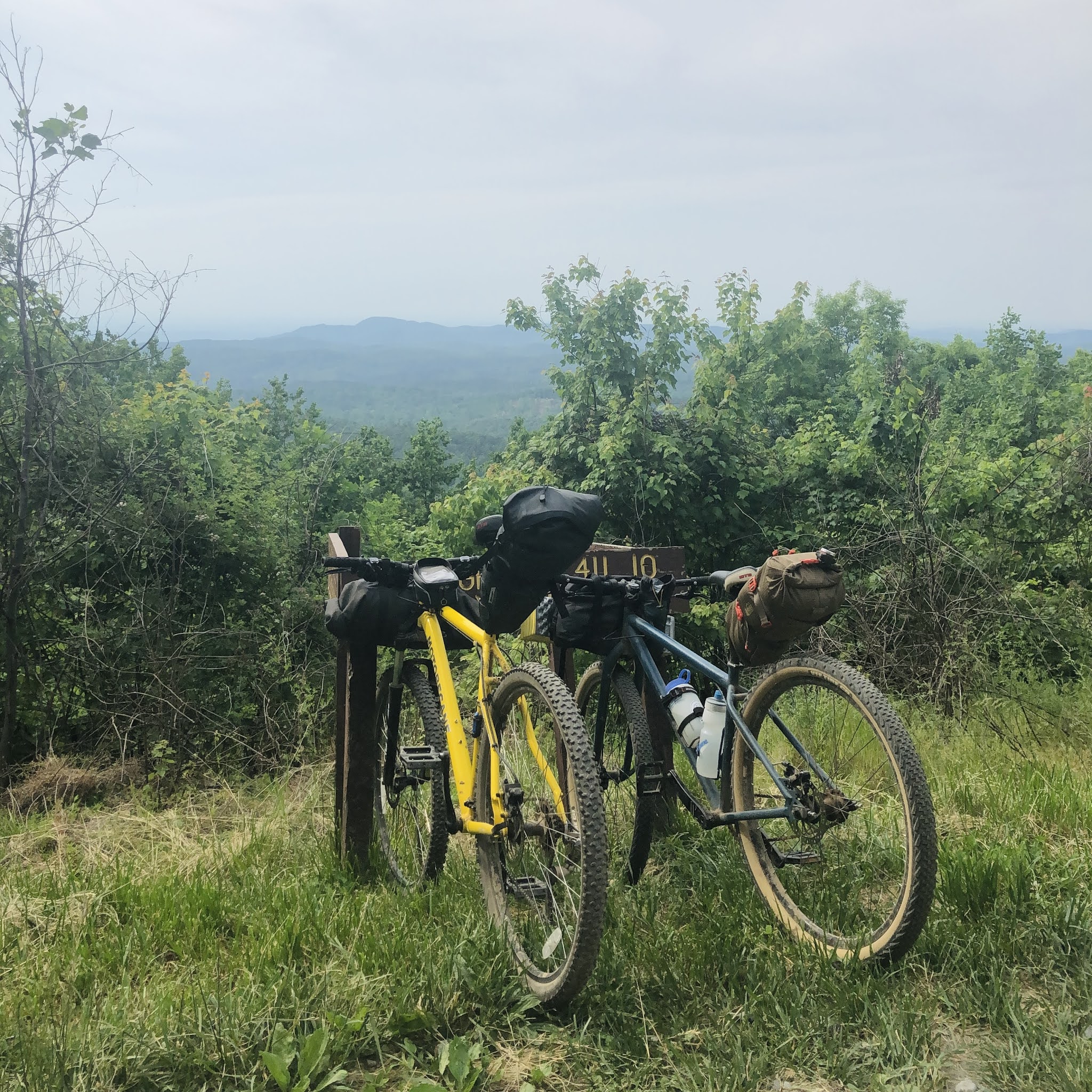
Less than a week after posting a blog titled, "The Art of Sucking It Up," I found myself sitting in the middle of a monstrous hill climb contemplating my existence and wondering if this was all worth it or not. Maybe not, but I did not want to keep going. When Max pitched the idea of riding the Cohutta Death March, I thought it would be hard but not that hard. As it turns out, this classic southern Appalachian gravel grind lives up to every bit of its name. I won't write a route description or trip report as many exist online, but you can watch an Instagram reel of our ride HERE

For the folks thinking about doing the route, I'll just say this: Max and I started at Cottonwood Patch Campground and did the loop counter-clockwise, which meant a 2,000 ft push condensed into just a few miles. This turned into a lot of hike-a-bike on my singlespeed, but even Max had to walk some of it. That said, I can't imagine doing this loop clockwise. I'd rather knock out the climb on West Cowpen Road the way we did and "coast" the back half (still a bit of climbing) instead of slogging up those gradual rollers and then squeezing my brakes the whole way back down to the valley. 


elevation profile for CW, we rode CCW 

Here's three things I learned while on the CDM: 
  1. Unless you want a raw tushy, do not sleep in sweat-soaked chamois. 
  2. Leftover pizza is the ultimate in bikepacking nutrition. 
  3. Max is a modern-day mystic; I think everybody should have a friend like him. In a world desacralized by modernity, Max still sees a world of mystery, meaning, and myth. Max inhabits, what Max Weber said of traditional societies, a “world that remains a great enchanted garden.” Everything is suffused and enveloped in import and our conversations demonstrated that. I think the way he reads the world is necessary and beautiful. He can also enter the Pain Cave with a Zen-like coolness that I am jealous of. I want to be a bit more like Max. 
the descents are hard-earned but fuuuuuuun 


Max

 Like this post? Continue to support megasplitter by subscribing to the mailchimp, commenting on, and sending the posts that you like to your friends.