Showing posts with label climbing. Show all posts

Sunday, August 14, 2022

Summer of '69 Syndrome

Climbing trip to Colorado (2012) from Kyle Sumner on Vimeo.

Summer of 2012, I headed west to Colorado. I did the same thing in 2013 and 2014, working for a backpacking guiding outfitter. In 2015, I headed west with my friend Josh. We had so much fun we did it again in 2017 and 2018. (I spent 2016 driving up, down, and around the Appalachians, climbing with anyone who would join me.) In the summer of 2019, I got married. That ruled. It still does. 

But the last few summers have looked different. 

One of the saddest tendencies of our species is the tendency to think that their best days are behind them. We all knew a guy still wearing his lettermen jacket years after graduation at the hometown bar. Maybe it's not the saddest, but it is pathetic. 

Let's call this desire to live in the past "Summer of '69 Syndrome." Named after, of course, Bryan Adams' baby boomer anthem that recounts the youthful bliss of summer. I like recounting those days too. It's fun. But the song repeats the line, "Those were the best days of my life!" Those were the best days of your life? Really? Nostalgia is a powerful drug and marketing strategy but come on, man. Get a life. 

My friend Leah and I worked together in Colorado, taking kids up mountains during some of those previously mentioned summers. We're neighbors now. She works with my wife, and her husband is one of my best friends. I'm at her house 1-2 times a week. We never really talk about "the glory days" because I think we're both in an unspoken agreement that the glory days are right now.

Wilderness Expeditions, Mt. Elbert, 2013

Yes, my summers look different. I sleep in a bed next to my life partner instead of a tent with my belay partner. I make my morning coffee in the kitchen rather than in the back of my truck. But I still use a Moka pot and I still get sweaty doing rad things and exploring beautiful places outside. 

Those trips dirtbagging and climbing around were amazing and I remember them fondly. They undoubtedly helped shape who I am. But instead of holding on to them like some kind of pearl of great price or faded letterman jacket, I try to let that adventurous spirit shape my life in this particular place: pushing myself to do hard things outside, coaching our school's rock climbing team, and exploring the creeks, cliffs, and hollers of the Cumberland Plateau. No, Mr. Adams, these are the best days of my life.

Summer 2022

*

Like this post? Continue to support megasplitter by subscribing to the newsletter, commenting on, and sending the posts you like to your friends. 


Monday, August 1, 2022

Ranking Chattanooga's Mountains

The Tennessee River Gorge

I love mountains. Living in Chattanooga, mountains surround me. From downtown, I am within a twenty-minute radius of no less than five mountains teeming with creeks, capped by cliffs, and sprawling with trails. They are what makes Chattanooga Outside Magazine's "Best Town Ever" twice and one of their 24 Best Mountain Towns in the U.S. for 2022. But not all mountains are created equal. That's why I have created a definitive, objective, and exhaustive ranking of Chattanooga's mountains.

About Our Mountains

 Some snobbishly inclined folks from America's "greater" mountain ranges thumb their noses at the Appalachians, especially the southern Appalachians. When I say I'm from Tennessee, these people turn into Crocodile Dundees of elevation. "That's not a mountain. That's a mountain." 

*shows you a google image search of Longs or Shasta* 
*flails on a southern V3 boulder problem or 5.8 trad line* 

Yes, our mountains are small. The Rockies would be too if they were 400 million years older and succumbed to the geologic pressure of erosion. 

In the ridge-and-valley province of the Appalachian region, mountains are long rather than tall. Lookout Mountain peaks at a mere 2,392 ft but runs 88 miles south starting from Chattanooga. Because of this, "peaks" and rises above the mountains' plateaus often receive local, colloquial names. For example, Raccoon Mountain is also Elder Mountain; I will use "Raccoon" because trash pandas are cooler than old people. This is also the case with Signal Mountain and Suck Creek Mountain. Both are part of the Cumberland Escarpment, known as Walden Ridge, that runs 74 miles through Tennessee. It all gets confusing. For my purposes, I will use Suck Creek Mountain to refer to areas west of and including Suck Creek Canyon and Signal Mountain for everything else.


A: Lookout Mountain
B: Mowbray Mountain
C: Raccoon Mountain
D: Signal Mountain
E: Suck Creek Mountain

About My Methodology

I rank the mountains according to arbitrary categories: swimming holes, mountain biking, rock climbing, etc. If you don't like my categories or think them insufficient, make your own mountain rankings. 

Points are awarded based on the quality of the category for each mountain. The point system goes as follows:

No (0 points): nope, nada, zero. This mountain does not offer anything in this category. Or it does but it's on private property which means it does not. I award this mountain no points and may God have mercy on your soul. 

Not really (1 point): Practically speaking, no. Sure, you could cool off in the pools above and below Glen Falls but you can't swim in them. 

Yes (2 points): This mountain has swimming holes or rock climbing or trail running and is worth your time but other mountains have better.  

Amazing (3 points): This mountain offers amazing recreation opportunities. Its [insert category] is unrivaled regionally and maybe even nationally (just look at the license plates in rock climbers' parking lots in winter around here). 


Admitting My Presuppositions

I've stood on summits from Maine to Washington, New Mexico to Canada. Little ol' Lookout is still my favorite mountain in the whole world. I've climbed hundreds of pitches (Mountain Project), logged  thousands of miles (Strava), and made a lifetime of memories (my brain) on this ancient prominence. I'll try to keep that love of place in check throughout my analysis.

Ranking Chattanooga's Mountains


Mowbray Mountain takes the swimming hole KOM with ease. From the ever-popular and ever-crowded Blue Hole to the not-so-secret-but-hard-to-get-to spots up in Big Soddy Gorge or Deep Creek: cold and clear wollerin' holes abound. Suck Creek And Signal Mountain have great roadside holes for a summer escape. Lookout gets a "Not Really" score because a truly majestic, God-tier, swimming spot exists but is inaccessible behind the private property lines of the Lula Lake Land Trust. Raccoon comes in last, though you could jump into the green, tepid waters of one of America's most polluted rivers if you wanted to. 

Rebecca about to take the plunge somewhere on Mowbray Mountain


Lookout Mountain's Guild-Hardy and Truck Trail systems are excellent after-work ramble or pieces of a bigger adventure ride. Expect everything from pea gravel to baby head-sized chonk. The area's best gravel is on top of Suck Creek Mountain in the Prentice Cooper State Forest. The main road offers 25 miles of out-and-back gravel grinding and the numerous Jeep spur trails make for rowdy and fun adventure biking. 

Alea, Brooks, and some folks I don't remember on Game Reserve Road


This is Raccoon Mountain's time to shine. The High Voltage trail was featured on Patagonia's "Best of Home" and I think the Live Wire trail gives it a run for its money. If you like technical and chunky riding with blistering, singletrack descents, then this is the trail system for you. Not to be outdone, Lookout Mountain features fast and fun mountain biking across its plateau. Many of which can be strung together via the 14-mile long Cloudland Connector Trail. 

Notice that Signal gets an alternative ranking because Walden's Ridge Park will be completed soon and offers downhill trails that people will want to travel from all over to ride. So that's cool.  

Brooks playing on the Chunky Trail of Raccoon Mountain


Again, everyone gets points here. If there are trails, then there's trail running. Raccoon comes in last because if you run here you may get mowed down by an unsuspecting mountain biker. I know because I've almost mowed down a few myself. They're MTB trails for a reason. 

Lookout Mountain's battlefield national park offers a web of trails that link up in a myriad of ways but its 10-mile Big Daddy Loop is its pride and joy. Suck Creek boasts the Pot Point and Mullins Cove loops. Both measure about 13 miles and can be done together in a figure-8 for a trail marathon(ish) that will kick you in the pants. Finally, don't sleep on Mowbray Mountain where the Cumberland Trail traverses its plateau and descends and climbs back out of its steep cliff-lined gorges. 

Rebecca descending the Bluff Trail on Lookout Mountain


Chattanooga drops the ball in this category, at least in its greater-metropolitan statistical area. Segments of the Cumberland Trail cut through Mowbray, Signal, and Suck Creek Mountains and make for nice overnighters but the real good stuff is a few hours away in the Smokies. 

Reid backpacking the Cumberland Trail on Mowbray Mountain


Everybody gets points here. Even you, RaccoonChattanooga is the crown jewel of southern rock climbing and maybe even climbing east of the Mississippi. My favorite single-pitch trad crag in the world is Sunset Park atop Lookout Mountain. Mowbray boasts overhanging sport climbing and world-class bouldering (LRC, yes but don't miss the horizontal roof-pulling down the road on the Cumberland Trail). Lastly, Tennessee Wall attracts trad climbers from all over the country to its orange and tan sandstone walls during the year's coldest months. Because "T-Wall" is southern facing, you can climb in a t-shirt in January. 

myself bouldering at the base of Signal Mountain

The Final Analysis: Chattanooga's Mountains Ranked


Suck Creek Mountain: 14
Lookout Mountain: 13
Mowbray Mountain: 11
Signal Mountain: 10 (though soon to be 12, probably)
Raccoon Mountain: 7

Chattanooga's best mountain is Suck Creek Mountain. You can climb the formidable cliffs of the Tennessee Wall; dunk in the numerous swimming holes along Suck Creek Road; run the Pot Point loop; backpack the Cumberland Trail; bike Game Reserve Road to Insurance Bluff; or car camp at Davis Pond. All of these reasons make it Chattanooga's best mountain -- even better than Lookout. 

*

Like this post? Support megasplitter by subscribing to the newsletter, leaving a comment, or sending the posts that you like to your friends. 

Sunday, June 19, 2022

Analysis: IPAs By Decade


November 2016, Josh and I headed up to the Big South Fork to climb the Standard Route of the O&W Wall. The Big South Fork is remote and wild, and the cliffs are intimidatingly tall by southeastern standards. At the top, Josh and I cracked open some cans of barley soda and enjoyed the gorge at its golden hour before making our descent. 


Once we returned to civilization and cell service (a McDonald's in Oneida, Tennessee), Josh posted a photo from the evening on his Instagram. Within minutes, vitriolic comments about our beer of choice  began blowing up the notifications on his phone. People did not approve of Busch. 


It was the 2010s, the height of the craft beer movement, and the Age of the IPA. Beer Wars was on Netflix, Fat Tire was no longer "fancy," and every town in Colorado had its own micro-brewery (8.4 breweries per every 100,000 21+ person, to be exact). Busch, and other single-name, macro-brewed, American-style lagers that retail for around $1 a can, were considered "cat piss.” According to Josh's refined friends and followers, we might as well have been a pair of slack-jawed yokels.


But that's all changed now. Beer taste has horseshoe theory'd back to the macro-brew, and now IPA's are the butt of jokes and memes. Micro and craft breweries have even started cranking out their own light lagers. But a six-pack will run you about $9.99 while a 12er of Busch costs and tastes about the same. That's basic economics. 

Speaking of economics, Busch and many other beers like Busch are union-made. And we should support labor unions. Unions are why our employers do anything remotely humane for us. And in the face of a fifty-year neoliberal onslaught on the working class, we should build worker power however and whenever we can; whether buying PBR or democratizing our own workplace. So here's a helpful list of union-made beers to get the revolution started. 
 
all-time great can design; bring it back, Busch.

*

 Like this post? Continue to support megasplitter by subscribing to the newsletter, commenting on, and sending the posts you like to your friends. 


Friday, April 15, 2022

Not My Words: Upon That Mountain

Paul scrambling the ridge of the East Face North Side of Seal Rock, Colorado

Trying to explain why we enjoy the things we enjoy is actually quite difficult. Why do I enjoy riding single-speed bicycles, climbing 5.4 multi-pitch, or eating Wendy's Baconators? Uh, because I do. How does anyone enjoy listening to The Beatles? I honestly do not know. Then again, I like music that's mostly yelling. I also enjoy reading mountaineering literature. In the excerpt below, early-20th Century alpinist Eric Shipton reflects on why he climbs mountains with a romantic eloquence far more charming and convincing than, "Uh, because I do." I thoroughly enjoy reading it and I hope you do too. 

It is impossible of course to provide an entirely satisfactory explanation for any recreation. The predominant motive in any human activity varies according to the temperament of the individual. Mountaineering provides good exercise in pleasant surroundings, a sense of satisfaction in overcoming difficulties, the joy, akin to dancing, of controlled rhythmic movement, a stimulating contact with danger, a wealth of beautiful scenery and a release from the tiresome restrictions of modern life. The expert likes to practice or display his skill. Some confess to having been drawn to climbing by a physical inferiority complex engendered by their failure at school to hit a ball straight and far. 
These motives are probably sufficient in themselves, and they certainly form the basis of many other sports. But in the deep devotion to any form of active endeavor there is generally something else we seek. In the case of mountaineering it is a kind of personal identification with the hills themselves, which comes of intimate understanding and strenuous contest and which brings with it a wealth of philosophical content. Above all, in my view, the attraction lies in the memory of those rare moments of intellectual ecstasy which occur perhaps on a mountain summit, perhaps on a glacier at dawn or in a lovely moonlit bivouac, and which appear to be the result of happy coincidence in the rhythm of mind and scene. These moments are not of course peculiar to mountaineering; they may be realized in deserts, on the sea and elsewhere. Such exaltation of feeling is achieved more often, I imagine, and in more normal circumstances by the mind of the creative artist, but for ordinary folk it would seem that it is more readily found in close contact with nature. -- Eric Shipton, Upon That Mountain (1944)

*

 Like this post? Continue to support megasplitter by subscribing to the newsletter, commenting on, and sending the posts you like to your friends. 


Sunday, January 16, 2022

The Future of Climbing

You've seen it. The local university outdoor club leaders going to bolt-to-bolt on the cliff's only moderate routes. The conga line of colorfully clothed gumbies waiting impatiently to top rope for the next several hours. The hammocks all flapping about like the sails of a hippie pirate ship. The "Mother of God! It's all toilet sounds!" music blasting from Bluetooth speakers. We've all seen it. Heard it. Heck, we've probably been a part of it. 


Last December, the Access Fund distributed an email with a picture of a similar scene at the Orange Oswald Wall near the New River Gorge. It asked, "Is this the future of climbing?" You probably remember the now-viral traffic jam of over 300 climbers on the Hillary Step of Mount Everest (if you don't, watch 14 Peaks on Netflix). Whether Ten Sleep, Wyoming, Sand Rock, Alabama, or the highest peak on earth, the problem of overcrowded crags isn't the future of climbing, it is the present reality. 


Climbing advocacy groups like the Access Fund and local climbing coalitions have two competing goals. On the one hand, they seek to increase access to an activity that is relatively exclusive. On the other, these groups seek to decrease the negative impact rock climbers have on the environment. These effects are infinitesimal compared to, say, a coal-fired powered plant but with rock climbing in the Olympics, Alex Honnold at the Oscars, and the proliferation of big business climbing gyms, more people are at the crag than ever before. The effects are noticeable. To be clear, I think these goals are inherently good. Diversity, inclusion, and the longevity of cliff base vegetation matter. But, like a good toprope anchor, these goals are opposite and opposed. It doesn't take a nihilistic alcoholic rocket scientist to know that more people climbing means more impact on the environment. Morty, meet pickle. 


It's a dilemma, but it isn't one without solutions, even if I personally do not know what those solutions are. Thankfully the fine people over on the Mountain Project forums do. 


Mountain Project posters with predictable profile pictures have taken it upon themselves to determine who does and does not have access to America's rock climbing, i.e., "gatekeeping." And it is almost always those who started climbing after the gatekeepers that do not deserve access. It's an ingenious idea that certainly would, if implemented, have positive results on our climbing areas. No new climbers! The implementation is the tricky part. Who's let in the gate? What year does one have to have started climbing? How established in the scene does one need to be? Are people who climb above a certain grade grandfathered in?  


Instead, I would like to propose an alternative to these Mountain Project posters, an alternative far easier to implement and far more effective for protecting wild spaces. Just stop climbing. Quit it. Walk out of that gate you made and leave it behind. I mean, when you took the photo of the overcrowded crag and complained about it at the bar later, were you not also there, crowding the crag? And when the boulder field parking lot was full, did you go somewhere else or did you park on the shoulder and work on your sick project anyway? It seems to me that the most responsible thing for a climber to do for the future of climbing is to quit climbing. 


There are so many other hobbies to choose from! Have you ever tried meditating? Trail running? Becoming a sommelier but instead of wine, you become an expert in Danimals® Kids Yogurt & Smoothies? Other such "hobbies" may include but are not limited to...


  • reading
  • baking
  • knitting
  • competitive duck herding
  • watching Lord of the Rings: Return of the King 362 times
  • Magic the Gathering
  • open water swimming
  • semi-professional stone skipping
  • weightlifting
  • staying more hydrated
  • hog calling
  • LARPing 
  • bird watching
  • mowing the yard with a pair of fingernail clippers

Each is as arbitrary and momentarily rewarding as on-sighting 5.12 or finally sending your boulder project. These hobbies are less time-consuming than volunteering with a local climbing coalition to conserve wildlife or working with land managers to preserve access. And each is far easier than mentoring a new climber in the ways of Leave No Trace principles, crag etiquette, and safe climbing practices. Ugh, creating an actual sustainable future for rock climbing is so much work! 


Protect America's climbing. Stop climbing and start being a Danimals® sommelier. 


*

 Like this post? Continue to support megasplitter by subscribing to the newsletter, commenting on, and sending the posts you like to your friends. 

Sunday, November 14, 2021

A Love Letter to My Little Legs


I'm short. Five-foot-six to be exact. I towered over my grandmother but I definitely have her to thank for these genes. I have short, stubby, muscular legs with T-Rex thighs and bowling pin calves. 

When I was a kid I was proud of my shortness. I got in a legitimate argument with my best friend over who was more deserving of playing Zacchaeus (a famously short Bible character) in the third-grade play. My hero was Muggsy Bogues and I would pray to God every night that I would take his place as the shortest player in NBA history. (Mr. Bogues was 5-foot-3.) Today, I have only three inches over the Charlotte Hornets point guard and not one iota of his basketball talent. 

Despite basketball's generosity to the vertically gifted, I played on the high school team. However, my membership on that team -- both athletically and socially -- was a bit of a joke. I wore Ramones t-shirts under my practice jersey if that tells you anything. In fact, the older I got, the more I learned to own my shortness through humor. In a college speech course, I recited the lyrics of Skee-Lo's "I Wish I Was a Little Bit Taller" before an audience of 30-40 people. They loved it. And before chubbies and showing thighs were a cool-guy thing, I was wearing short shorts to be funny.

It wasn't until I started rock climbing that I mastered the art of self-deprecating humor. Climbing like cycling or running places participants under significant pressure to achieve an "ideal" physique. Body image issues are a pervasive societal problem so it's no surprise that endurance sports, which serves as a microcosm of the society at large, has their own body image issues. And studies show that the demand for the ideal body does not discriminate based on gender either. 

Enter any climbing gym in America and you're bound to see and hear traditionally beautiful people with no shirts on talk about diets, nutrition, and weight loss. Those aren't inherently bad things but it underscores how obsessed climbers are with appearance (often cloaked in the language of performance). So there I was, in the gym or at the crag, definitely keeping my shirt on, blaming my "Cee-Lo Green arms," my "Oompa-Loompa legs" or my "prepubescent wookie" body for my failures to send. People particularly loved the "prepubescent wookie" bit. It's legitimately funny. But not to my therapist who, years later, would call me out on this defense mechanism during our first or second session. 

To be clear: I am not trying to say my struggle to be comfortable in my own body was the same as the next person's. And I wasn't going to therapy because of it. It just naturally came up during the session because I was so habituated in the ways of making fun of myself. And not knowing or loving oneself can lead to a myriad of unwanted behaviors. What I am trying to say is that a lot of us -- a lot more of us than we realize -- struggle with being at home in our body more than we care to admit. Even or especially(?) if you participate in outdoor endurance adventure sports. 

While I was going to counseling I was also training for an ultra-marathon. I wasn't fast. I wasn't good. If I didn't have a "climber's body" (whatever that is) then I most definitely did not have a "runner's body" (whatever that is). (PSA: all bodies are climbers' and runners' bodies.) When I was fifteen, my basketball coach told me I ran like a 40-year old man. By that math, I was running 31 miles like an 80-year old man. But I did it. My short little legs ran 34 miles up, down, and around Lookout Mountain. At the time, my friend Josh and I were only the 8th Strava users to do the Big Daddy Loop Threepeat. 

Since the 50K wasn't a race or sanctioned event, I got no running bib, completion medal, or cool t-shirt. What I did get was a healthy sense of self. None of my therapist's "homework" assignments got me to think about my body and myself differently. Ultra-running did. Running helped me live in my body with confidence and compassion. After the 50K, though, my interest in running has been negligible. 

I reserve the right to be wrong about everything, but riding a bike is much more fun. While I worked on a draft of this post, I got to ride my bike with Catalyst Sports Adaptive Mountain Bike Tour. Some of these athletes could pedal a bicycle; others used hand-cycles or e-assisted bikes. All of them ripped around the trails with the kind of grin that I think few things other than a bicycle can provide. One rider talked about how the event made him feel human again. Another shared that adaptive cycling helped them learn to love themself after years of hating their body.

I have half a dozen takeaways from riding with these athletes and here's just one: human-powered outdoor adventure sports have a great capacity to heal. Outdoor adventure athletes, brands, and marketing have a great capacity to hurt, sure. But strip all that away -- grades, PRs, and K/QOMs too -- and you're left with something simply amazing, liberating even: the discovery of one's abilities through moving your body outdoors.

My short but capable legs have done a lot of rad things. I'm proud of them and what they've done and where they've been.

Like this post? Continue to support megasplitter by subscribing to the mailchimp, commenting on, and sending the posts that you like to your friends.  

Monday, July 19, 2021

Rock Worrier's Way

Independence Pass, summer 2015

You've felt it. A change in the air. A turn in the tide. A dramatic decrease in the posts about rock climbing. 


It began in 2018. Josh and I had just returned from the Red River Gorge when he got the phone call. His friend, Savannah, fell and died at Devil's LakeHer death sent shockwaves through the climbing community. They say if you climb long enough, someone you know will die in the mountains. I barely knew Savannah, I bouldered with her once or twice, and we followed each other on Instagram, but that was enough for me. I didn't realize it at the time, but my relationship with rock climbing had just begun to change. 


It wasn't instantaneous. Shortly after Josh and I got off the phone, I called up my buddy Andrew to climb at the Tennessee Wall. I needed to climb a parallel-sided crack to remind myself I still could. I did. But, in the weeks and months after, my head game slowly deteriorated. I got nervous driving to the crag. I second-guessed my gear placements. I let my partner lead, or I backed off routes more than I used to. I used to enjoy whipping -- even on gear -- but not anymore. Instead of stoke, climbing filled me with worry, dread, and anxiety. I was scared. And yet, I kept doing it. 


A year later, almost exactly, Russ and I were headed off to climb 3,000 ft. for our 30th birthday. As we loaded up the truck, my then-fiance/now-wife kissed me goodbye and somewhat jokingly said, "don't die!" She probably didn't think anything about it, but those words lived rent-free in my head for the rest of the trip. 


I wasn't just some untethered school teacher who moonlighted as a dirtbag climber anymore. My life intertwined itself with another's. (The truth is, all our lives intertwine themselves with others' -- we only so often consider it in romantic or partnered relationships). This realization made death a tangible reality. What if I had slipped while free-soloing in the Flatirons? What if I had decked on that R-rated route? What if I made a careless but common mistake on rappel? These thoughts still wake me up at night. 


Russ and I were about 2/3 through our objective to climb 3,000 ft. when I stood at the bottom of a route I had done before. It was well within my on-sight ability, all the routes we had done were. But looking at its base, I felt nervous. I could not remember the sequence of moves or the path of least resistance up the first pitch of the blank slab, so I passed the lead over to Russ. He ran it out without hesitation. 


The second pitch begins with a blind "trust fall" "boulder problem" across a deep chasm. I once led this pitch while simul-climbing but my head game had deteriorated since then. It felt like vertigo. I thought it was dehydration, but I could feel Becca's words, "Don't die," swirling around in my head. I told Russ some lie about how "you got to lead this pitch, dude, it's wild!" I was trying to sell it as some requisite experience instead of being honest and saying, "Hey, I'm too afraid to do this thing." Russ led it, got off route after the "peek-a-boo move," and struggled to on-sight a much harder variation, which I then followed. By the time I got to the anchors, I had tunnel vision. I felt dizzy, and I even forgot how to tie a clove hitch. Russ tied me into the anchor and led every technical pitch for the rest of the day. God bless him. 
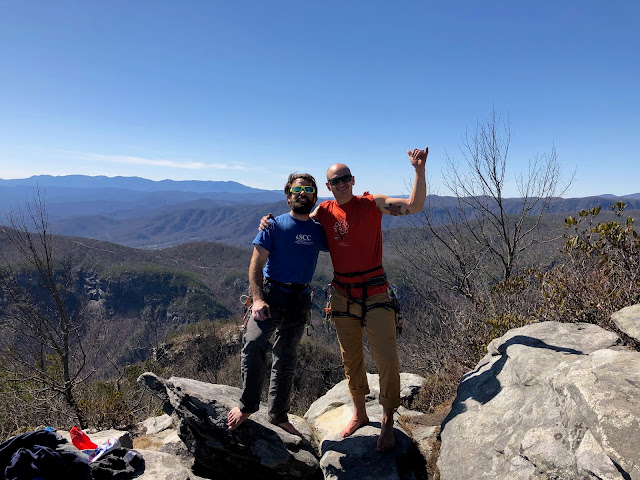

3,000 ft. for 30 years, 2019


I don't know what happened that day in North Carolina, but that was it. That was the straw that broke the camel's back. I thought, for a while, that maybe I'm just getting older, and I'm getting more conservative in my risk assessment. But if that was the case, shouldn't I, at least, be enjoying the fun parts? The well-protected routes with classic moves and four-star peer-reviews? I wasn't. Something changed. I continued to climb, but I never enjoyed it in the same way. I spent the rest of 2019 focusing on ultra-running, which was a good distraction and a good excuse not to go to the crag with your friends. When the pandemic hit in March 2020, I basically quit climbing altogether. 


Many climbers used the pandemic to get stronger, I used the forced hiatus to rethink my relationship with the sport. I spent a decade building an identity around being a climber. To stop cold turkey on March 7, 2020, is almost impossible to describe. On the one hand, it feels like a large part of me has died. Rock climbing means so much to me. It gave me friends, memories, and disproportionally sized latissimus dorsi muscles. I took a lot of pride in being a "climber." I miss my bulging forearms and noticeably stronger ab muscles. I miss climbing trips with Josh or grabbing a pint after a day at the crag. 


Horse Shoe Canyon Ranch, 2014


On the other hand, I don't miss climbing at all. I don't particularly miss the act of climbing. If I did, I'd still be interested in sport climbing but heel hooks just don't make me grin the way they used to. I don't miss the "always-have-to-be-training" grade chasing bravado of the Chattanooga climbing scene. And I certainly do not miss calculating the length of my fall relative to the size of gear protecting me. Or having to do breathing exercises in the middle of the route just to slow my heart rate enough to reach the anchors. Rock climbing is supposed to be fun, but the last two years of climbing contained more dread than stoke. It's also an inherently unnecessary activity. So why did I feel compelled to do something I wasn't enjoying? 


For me, rock climbing was always about being outside with one or two close friends. It combined my life-long love of the outdoors with the try-hard/risk-management of skateboarding in my adolescence. But now, I managed risk differently, and I needed a new way to be outside. 


Like many Americans in 2020, I bought a bicycle in quarantine. It was a bike a lot like the bike I sold to help fund a climbing trip several years ago: a no-frills singlespeed track bike. It took one lap around a parking garage to fall in love all over again. I have built or bought four bikes since, and I found that the joy I get from cycling is longer-lasting and more easily achieved than from climbing. I might even love riding bikes more than I ever loved rock climbing, and for ten years, I LIVED for climbing. 


Maybe "living for climbing" is why I'm still not willing to sell my trad rack quite yet (feel free to make me an offer). Rock climbing still is a large part of my life. I will probably continue to coach the school's climbing club. "5.fun" multi-pitch still sounds appealing to me. And sometimes, I daydream about concocting some Type II fun bike-to-climb adventure objective. But for now, rock climbing and I are taking a break. And that's okay.

Like this post? Continue to support megasplitter by subscribing to the mailchimp, commenting on, and sending the posts that you like to your friends.