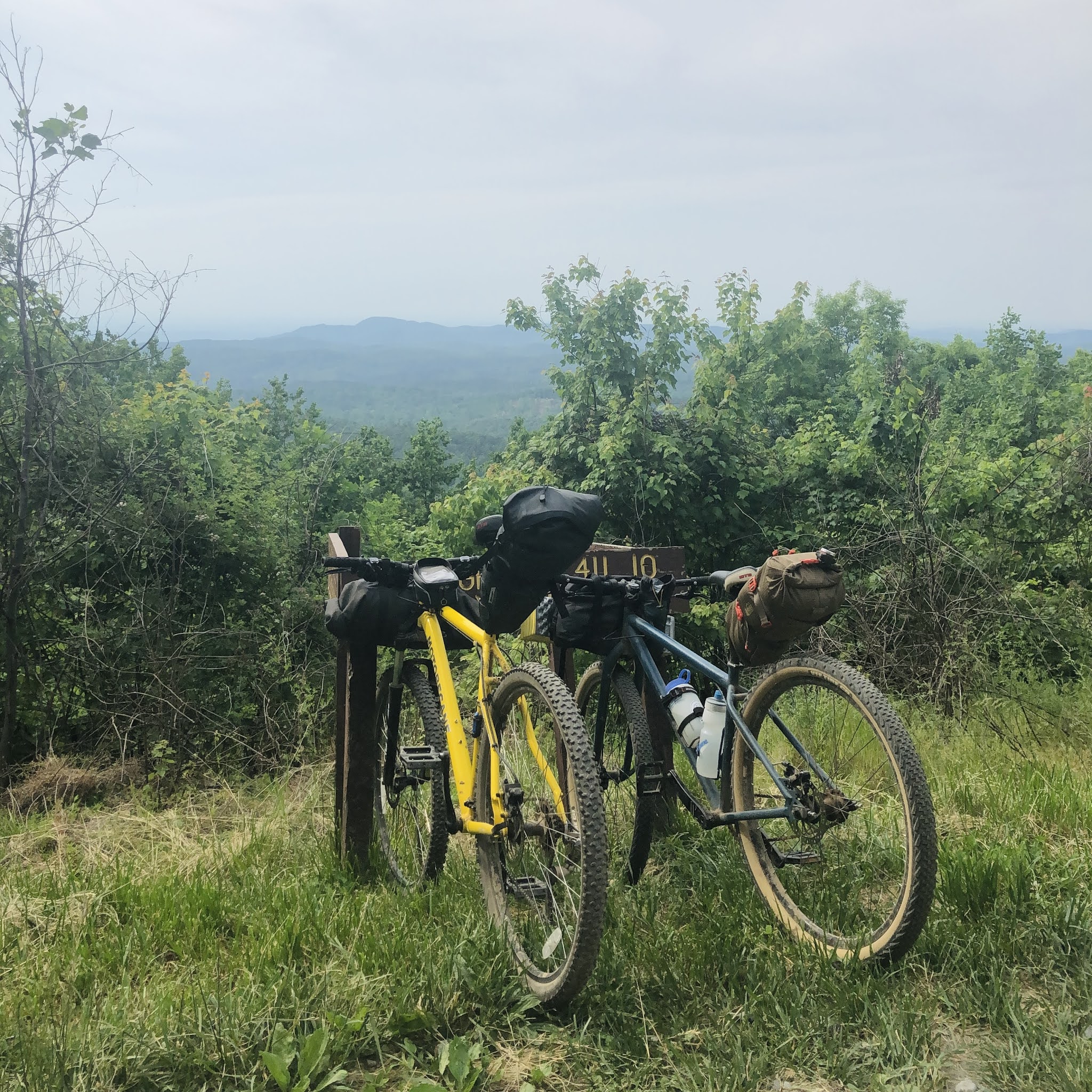
| Lookout Mountain, Georgia |
![]() |
| Cloudland Canyon State Park |
*
Like this post? Continue to support megasplitter by subscribing to the newsletter, commenting on, and sending the posts you like to your friends.
| Lookout Mountain, Georgia |
![]() |
| Cloudland Canyon State Park |
*
Like this post? Continue to support megasplitter by subscribing to the newsletter, commenting on, and sending the posts you like to your friends.
| source: instagram |
"In its need for special clothing, bicycle riding is less like scuba diving and more like a pickup basketball game." -- Grant Petersen, Just Ride: A Radically Practical Guide to Riding Your Bike (2012)
*
Like this post? Continue to support megasplitter by subscribing to the newsletter, commenting on, and sending the posts you like to your friends.
| Suck Creek Canyon and the Tennessee River Gorge |
Sleeping outside is good for you. Evidence? Oh, so you’re Mr. Science Guy now. Here’s a sentence from the Journal of Environment and Behavior that’ll make you absolutely want to scrape your eyeballs out:
“Analysis revealed a positive, linear association between the density of trees and self-reported stress recovery, adjusted R2 = .05, F(1, 149) = 8.53, p < .01.”
STEM ruins beauty. Compare that to this poem by Wendell Berry:
"I go and lie down where the wood drake rests in his beauty on the water, and the great heron feeds. I come into the peace of wild things who do not tax their lives with forethought of grief. I come into the presence of still water. And I feel above me the day-blind stars waiting with their light. For a time I rest in the grace of the world, and am free."
I spent the year trying to regularly, once a month, rest in the peace of wild things and it was liberating. This dumb little goal helped me feel a lot more like myself but I have no evidence to prove it and also I'm no poet. So here's some beauty-ruining data and crappy iPhone photos from a year of sleeping outside once a month.
| Figure 1 |
| Russ vintage mountain bike-packing through north Florida pine forests |
| Figure 2 |
Ten out of 11 trips were with friends. I think that speaks for itself. I also appreciate the variety of folks I was able to share these spaces with; ranging from my life-long best friend, Russ to Reid and Leah and their one-year-old daughter. Max and Brooks take the cake for most trips (Max was part of the King Family Campout).
| Max riding out of the fog in Prentice Cooper State Forest |
| Figures 3.a and 3.b |
Getting outside doesn’t have to be complicated. “Aim small, miss small.”80% of these monthly adventures were overnighters within an hour or two of home. This is pretty easy in a town like Chattanooga and I'm thankful for that. But I think that a lot of us can find these small adventures near our respective towns.
| adventure from the front door somewhere on Lookout Mountain |
83% of nights slept outside were on public land. Public land conjures images of dense forests and spacious deserts managed by the US Forest Service or Bureau of Land Management but let's not forget about our state parks! State parks get a bad rap, I think, because, well honestly, they can be bougie and touristy and feature things like zip lines and golf courses. But some of our iconic outdoor spaces are our state parks: Eldorado Canyon in Colorado or Cloudland Canyon in Georgia. What incredible resources we should protect.
| Becca overlooking Savage Gulf at the South Cumberland State Park |
| Figure 5 |
| all that bikpacking and only one flat... |
| Figure 6 |
I slept outside for years, months at a time even, without owning a tent. Cowboy or cowgirl or cowperson camping is the purest form of sleeping outside and it’s in my blood. I finally bought my first nice tent back in 2018 and I got some good use out of it this year but I still prefer no separation between me and the open air. Again, I want to emphasize the point that camping doesn't have to be complicated. Camping tentless is lighter, simpler, and in my opinion, better.
| Brooks cowperson camping in Suck Creek Canyon |
*
Like this post? Continue to support megasplitter by subscribing to the newsletter, commenting on, and sending the posts you like to your friends.
![]() |
| photo by Brooks |
Unpopular opinion: I love hike-a-bike. I really do. Hike-a-bike is the act of pushing, pulling, or carrying your bike, usually because the terrain is too steep or too loose to pedal. In the bicycling community, this would be like saying, “I enjoy paying taxes” or “I love washing the dishes.” A friend once threatened to extend the ride by 13 miles just to avoid a short hike-a-bike up a steep horse trail. Paying taxes, washing the dishes, or pushing your bike up a hill can be difficult and tiresome but also incredibly mundane - Sisyphean even.
Thich Nhat Hanh claimed you can meditate while washing the dishes. Think about that. The second most-famous living Buddhist (second only to the Dali Lama), a world-renowned and revered Zen master says you can do this transcendent-touching, nirvana-actuating activity while doing something as banal as washing your dishes. That’s amazing. And, I think, if you can meditate while doing the dishes, you can meditate while pushing your bike up an enormous hill. If you don’t ride a bike very much, copy and paste this into your word processor and word search and replace “hike-a-bike” with whatever “hard thing” it is that you do. The same can probably be said about trail running, climbing off-widths, or sinking a putt for birdie.
A Buddhist once described meditation to me as the middle of a three-circle Venn diagram, where the three circles are concentration, awareness, and mindfulness. Concentration is the ability to focus tightly on an anchor or object of meditation. Richard Rohr, a Catholic contemplative, describes this exercise as “a long, loving look at the Real.” While a ridgeline, the end of a switchback, or the backside of your friend who’s way ahead of you is not the Ultimate Reality, I find the ability to focus tightly on an anchor like this good practice for the real deal — the lotus position under a bodhi tree or washing the dishes kind of real deal.
Awareness and mindfulness are more difficult to differentiate. Both help us be present. Anyone can white-knuckle grin and bear it to the top of a hill. Or clasp their eyes shut until finally the singing bowl bell gongs. I have. These experiences sucked. Meditation is more than the furrowed brow of concentration. It also requires the space to have a sense of all that is happening around you. In other words, having a sense of our physical sensations and mental contingencies while keeping an object of meditation.
The textural sound of pea gravel beneath my shoes and tires. The pleasant ambiance of the forest: locusts, birds, and streams. The feeling of sweat in my mustache, hunger in my belly, and fatigue in my legs. Seeing the path of least resistance ahead of me. Noticing the rutted dirt, the blocks of rocks, or even the owl in the tree. Noticing it all for what they are while ever moving toward the anchor. That's meditation.
If this sounds all too much for you, try this. The next time you’re pushing your bike up some heinous climb, take some deep breaths. Begin to notice 5 things you see; 4 things you hear; 3 things you feel; 2 things you smell; and 1 thing you taste. I promise you won’t regret it. You may not achieve nirvana but you’ll be closer to getting back on your bike and with a more “present-presence” than you would have otherwise. I think a 20% grade climb up loose gravel in a forest is a worthy monastery or meditation cushion. There are no to-do lists, emails, or notifications. Really, the only thing that exists is the present moment. So just be there. Or rather, just be.
Meditation or looking deeply, Thich Nhat Hanh says, is to see the true nature of things. Which, according to Buddhism, is to see and understand things as impermanent. You don’t have to be Buddhist to appreciate this. The hill I am pushing my bike up; the feelings of joy and grief I experience; the thoughts of compassion and greed that come and go inside my head; indeed, my very life is not forever. How could they? The future doesn’t exist (this is a hill I am willing to die on).
Don’t believe me? Listen to Marc E., from Collection 8, Episode 3 of The Great British Baking Show. Marc finished his showstopper dharma wheel cake while the other bakers worked frantically to finish their final touches. Sitting on his stool, like a zen master with a Cornish accent, he counseled,
“I take every opportunity I can just to take a mindful breath. Just kind of brings me back to the present moment. ‘Cause when you think about it, when we’re worrying, we’re worrying about things that happened in our past. Or [we’re] worrying about the future. And ultimately, we’ve got no control over that, have we?… Of course, it’s easier said than done.”
![]() |
| Figure 1 |
I'm no Alex Howes but I've ridden my bike enough to notice some things. For example, the more miles I ride, the more pizza I need. The more pizza I eat, the more miles I need to bike. (Fig. 1). I've noticed other things. Like, cyclists love data. Cyclists are on Strava because they crave the data. They need the data. They want to become one with the data. And since I am a visual learner who loves charts and graphs, I have systematized the data for you to consume and become one with. Let's start with some easy direct correlations and ease our way into more advanced behavioral economics.
![]() |
| Figure 2 |
A redneck friend of mine said that anybody with tires over 33” is compensating for something. Whether that is true or not, and it definitely is, it is true that anyone driving a truck with tires over 33” is guaranteed to not give you your three feet (T.C.A. §55-8-175). This is especially true if they have a Punisher symbol anywhere on their Jeep or truck. These people do not care if you live or die, and they take some pride in that misanthropy. I am nearly convinced in a medieval, Dantean, abysmal hell because of people like them. Essentially, the bigger the truck: the bigger the pile of loose, sloppy stool in the driver's seat.
![]() |
| Figure 3 |
![]() |
| Figure 5 |
![]() |
| photo by Ry |
The Therm-a-Rest Z Lite has been in production since 1989. It's used by alpinists in Denali National Park, thru-hikers on the Appalachian Trail, and bikepackers on the Tour Divide. There are hundreds, maybe thousands, of reviews online. Why do the internet and your email inbox need another one? Because alpinists, thru-hikers, and Tour Dividers are hardcore. These folks can rough it. But what about the normal folks, the weekend warriors, the semi-rad fun-hoggers looking for an outdoor sleep system? Let me tell you.
I have slept outside on a Therm-a-Rest Z-Lite sleeping pad since 2013. Before that, I had a Therm-a-Rest Ridgeline I cut and duct-taped back together to accordion fold like a Z Lite. This did not work well. I have put my Z Lite through the wringer, spending hundreds of nights sleeping on dirt, sand, rock, and snow on this 3/4 inch thick piece of dimpled foam. It is amazing. I fiddled around with inflatable pads from the industry's giants -- Therm-a-Rest, Big Agnes, and REI -- but I always came running back to the indestructibility of the Z Lite. No popping. No waking up in the middle of the night on the ground due to a slow leak. No snorkeling in the bathtub trying to find the impossibly small hole in need of repair.
However, the Z Lite has a lot of naysayers. "It’s not plush enough." "It’s too dirtbaggy." "It’s not for side-sleepers." Of course, none of these are true. I recently returned from a camping trip with family. This kind of camping involved extension cords running to box fans inside massive dome tents filled with queen-sized air mattresses. They were all flummoxed when Rebecca and I put together our tiny backpacking tent and their jaws hit the ground when we whipped out our matching set of Z Lite sleeping pads. My sister-in-law was even concerned if we were "going to be okay." Eventually, I convinced her husband to lay on it and he said in five words what reviewers at Outdoor Gear Lab, Backcountry, and Gear Junkie have struggled to say in hundreds of user reviews:
"Oh, it's not that bad."
And then he fell asleep. Like, he took a nap right there. This is the power of the Z Lite. It's really not as bad as the inflatable crowd says. My brother-in-law's laconic pre-slumber gear review got me thinking about some more 5-word reviews for this industry standard:
You can sleep on it.
It's only a few nights.Tummy sleeper? No! Buy it.
Maybe don't if you're eighty.Basic comfy pad cuts mustard
Closed cell foam gold standard
Let's be real: it's cheap.
It gets the job done.
Super-lightweight and ultra-durable
And if hyphenated words count as one word: super-lightweight, ultra-durable that never fails.
*This gear review was not sponsored by Therm-a-Rest and I purchased my Z Lites with my own hard-earned monies. This review was also more than five words. 544 to be exact. I apologize. But please continue to support megasplitter by subscribing to the mailchimp, commenting on, and sending the posts that you like to your friends.
![]() |
| Big South Fork photo by Ry |
![]() |
| a really great candid or just me checking for ticks photo by Brooks |
![]() |
| mermaid Brooks photo by Ry |
Aside from our team of six dwindling to a team of three before our departure date (and our night on top of Parkers Mountain) this trip went according to plan. We met our singular objective: have fun outside on bikes. Inadvertently, our trip also lined up with the Swift Campout weekend. I'm essentially a Quaker, but I'm too much of a sacramental theology nerd to actually convert. So, to me, it felt a bit eucharistic to know I was partaking in this sacrament of nature with people all over the world at the same time. Here are some other lessons learned along the way:
1. I think my favorite kind of riding is horse trails. Every horse trail I've ever ridden has been absolutely heinous. Not designed for bikes or cars or even bipedal animals, horse trails hit this sweet spot between gravel biking and trial biking. Bombing down a steep grade with loose rock chunks the size of my two-year-old niece's head on a rigid bicycle makes me feel like a poor man's Danny MacAskill. Yeah, I crashed. And yeah, I still loved it.
2. When a one-eyed man and an ex-carny with multiple Insane Clown Posse tattoos tell you where a swimming hole is, you go.
3. When you don't want to share a campsite with a one-eyed man, an ex-carny with multiple Insane Clown Posse tattoos, a gun-toting and ax-throwing woman, and their multiple screaming children, it's okay. Don't feel bad. Even if they invite you to share their chili. Or especially if they invite you to share their chili.
You can watch an instagram reel of our ride here:
![]() |
| viewpoint midway up Cowpen Road |
![]() |
| elevation profile for CW, we rode CCW |
![]() |
| *~SpRiNg BrEaK 2007~* |
Have you ever woken up to a pack of raccoons tickling your feet? I have. I was 18 years old, camping on the eastern end of St. George Island with Russ. It was spring break and we were backpacking with our skimboards in tow. Two seniors in high school living on the beach for spring break? I had high expectations. I can't speak for Russ but I had envisioned the trip to be like hiking into the actualized lyrics of Katy Perry's "California Girls." But my eighteen-year-old brain vastly overestimated how many "daisy dukes, bikinis on top" would be hiking to a primitive backcountry campsite on the beach. The sum total was zero.
Instead, the trip went like this: Russ and I backpacked into a desolate campsite by the bay. It was cold. Sand filled every crevice of our bodies while sand gnats and mosquitos ravaged every exposed piece of our flesh. We wore makeshift burkas to shield our faces from the bugs. Even the skimboarding was bad. A couple of nights in, I forgot to hang our food and awoke under my tarp tent to a pack of raccoons tickling my feet, searching for treats. I got Russ up, packed our bags and hiked out.
Some cherished memories happened that night, like hiking without headlamps by the starlight over the Gulf of Mexico (Russ told me years later, it was so beautiful he cried). But that doesn't change the fact that we gave up. We quit. When it got hard, we went home. That wasn’t the only time something like that happened either. In fact, Russ and I began making “a thing” out of hiking out in the middle of the night to find the nearest Waffle House. It was fun. But as I began to spend more time outside and the trips got longer and more remote, there weren’t any Waffle Houses to retreat to. Eventually, I had to learn the art of sucking it up.
You should read Haruki Murakami's What I Talk About When I Talk About Running. There's this line: “Pain is inevitable. Suffering is optional.” I think about that all the time when I'm out trail running or rock climbing because I have a choice in how I respond to pain and discomfort: give up or keep going.
Renowned psychiatrist, Viktor Frankl maintained that between stimulus and response, there is a space. And, “In that space is our power to choose our response.” Whether climbing mountains or running long distances, I think human-powered endurance activities help build the muscles used to make the responses required for suffering in the real world too.
Whether you’re running an ultramarathon and every muscle in your right foot is screaming...
Or you’re festering in a tent while bad weather batters your high camp...
Or you’re working two jobs to pay off medical debt from a routine hernia surgery because Americans pay 40% more for healthcare than the rest of the industrialized world...
Each creates a space where the pain is inevitable but the suffering is optional.
"Suffering," here, is the choice made to see it through. I don't mean this to romanticize or make light of anyone's actual physical, emotional, existential suffering. I think there's a difference between suffering and "things that suck." Yet it's all very subjective. And to be fair, navigating a pandemic, working an unsatisfying job, or arguing with a partner is not the same thing as trad climbing, ultra-running, or waking up to raccoons sniffing your feet. But the ability to take a deep breath, figure something out, and keep going when you're in the mountains might also help when you need to plan a budget, discuss your feelings, or finally find a therapist.
Alpinist Kelly Cordes said of ultrarunners, "To keep going when given the option to quit is hardcore." If you're reading this then you made it through 2020 and you probably suffered something. We all learned a little about the art of sucking it up this year and I think we all got a little more hardcore. On a recent bikepacking adventure with Russ, I brought up that 2007 spring break trip. I talked about how thankful I was that playing outside taught us the same lesson running taught Haruki Murakami. Russ looked at me and spoke through the cloud of mosquitos and campfire smoke."It's funny you mention that," he said, "because I really wanted to call it quits today." We laughed and kept eating our ramen bombs and then we got back on our bicycles the next morning.
Like this post? Continue to support megasplitter by subscribing to the mailchimp, commenting on, and sending the posts that you like to your friends.