Showing posts with label sufferfest. Show all posts

Sunday, May 15, 2022

The Buddha and the Pain Cave


Running hurts. Anyone who tells you otherwise probably says wheatgrass juice tastes good too. (It does not.) Some want to pretend that running is always social media-worthy, but running will almost always bring you to a point where you look like death and everything sucks. That, to me, is part of what makes it so beautiful. 

My favorite running photo is of the finish line of a hundred-mile trail race. A middle-aged man weeps as he struggles to make it across the finish line before the cut-off time. He's fighting, with everything he has, for dead last place. And everyone around him is going berserker to cheer him on. It's heartbreaking and beautiful and I wish I could find the link to it. I like running because it pushes the body and brain beyond the threshold of discomfort. It requires the runner to dwell in the pain cave.

The "pain cave" is a term used by endurance athletes to describe the deep, dark place where physical, mental, and emotional fatigue coalesce. It sounds bleak and yet you'll find about 3,830,000 google results for "embracing the pain cave." Many feature ultra-runner Courtney Dauwalter, who is largely responsible for popularizing the term. If you don't know who Courtney Dauwalter is, her ultra-running rap sheet is impressive. My favorite tidbit is her performance at the 2017 Moab 240 (that's 240 miles). Dauwalter finished in first place, kind of a big deal. She also finished 10 hours ahead of second place, which is a remarkably huge deal. Close your computer and ponder the world's greatest athlete you've never heard about. Courtney Dauwalter knows a thing or two about pain and how to deal with it.

Pain is the language our body uses to tell our brain that it does not like what is happening. I love this line from Haruki Murakami's, What I Talk About When I Talk About Running: "Pain is inevitable. Suffering is optional." It's a Buddhist saying. The implication is that the body feels pain but the brain chooses what to do with it. You could give up. You could quit. Or you could delve deeper into the pain cave. Descend into the recesses of your mind and find the inner mental strength to carry on.

Watch any Courtney Dauwalter interview on youtube and she's grinning ear to ear as she talks about the pain cave. It could be her bubbly personality. Or it could be a peculiar love for this dark and agonizing mental space. For Dauwalter, the cave is the place to grow as a runner and a human being. 

Some runners transcend the pain altogether and achieve a "runner's high." I am not one of them. When I enter the pain cave, I bring an imaginary tent and sleeping bag because I'm going to be hurting for a while. I don't always tap into my inner-Dauwalter. Sometimes I have a pity party and cut my run short. I am not a world-class endurance athlete. I hesitate to call myself an athlete at all. But I do know that if I dig deep enough, enough times, my brain actually can dominate the body. And I've got pretty good at settling into the pain and suffering my way through things. Even when I hate it, I love it. And I almost always want to do it again.


I teach comparative world religions to eleventh graders in high school. I love my job. My favorite unit to teach, but the hardest for my students to grasp, is Buddhism. The First Noble Truth uttered by the Buddha is that life is suffering (dukkha). It is always interesting how my students respond to this assertion of the world. For many, it seems bleak or pessimistic. Still, others nod their heads in affirmation. Divorce, sickness, loneliness, death, poverty, bullying. Many students are acutely aware of the reality of pain. 

Last fall, in the middle of my Buddhism unit, our school experienced an awful object lesson in the truth of suffering. "If we are afraid to touch our suffering," Thich Nhat Hanh explains, "we will not be able to realize the path of peace, joy, and liberation. Don’t run away," he continues, "Touch your suffering.” This is the meaning of the First Noble Truth. And so that's what we did.

We didn't run away. 

We touched our suffering. 

We entered the pain cave. Sat with it. Kept company with the pain and suffering. Only then, the Buddha says, one can be on the path of release. But that's hard work. We'd much rather stuff it down, compartmentalize it, or run away. We put smiles on our faces and say we're good when everything seems like it's falling apart. This emotional bypassing is a pathological condition among Western folks, especially Western Christians. I mean, consider the great American folk song but the God-awful theology of the hymn, "I'll Fly Away:" 

Some glad morning when this life is over, I'll fly away!  Just a few more weary days and then, I'll fly away! Yeah, when I die, Hallelujah, by and by, I'll fly away!

This is either the ramblings of a psychopath with a death wish or a neo-platonic perversion of the gospel. Either way it's dirty brown water trash. Instead, the Buddha instructs us not to escape from life "but to help us relate to ourselves and to the world as thoroughly as possible" (Hanh). Yearning for a better life after death is passive. The Buddha encourages us to be active. Lean into the suffering and work towards its cessation here and now (Cūḷamālukya Sutta). "To be truly happy," insists Arya Namdol, "one must be intimately connected to and bear witness to suffering" (Namdol). That's a valuable lesson, even for non-Buddhists and, especially, for Western Christians.

Life, like running, involves tremendous suffering. But that is not the whole of it. The Buddha indeed taught the truth of suffering, but he also taught the truth of "dwelling happily in things as they are" (Samyutta Nikaya). And that, to me, is the meaning of the saying, "Pain is inevitable. Suffering is optional." And that, to me, is the work of the pain cave.

So the next time you are edging toward the dark gaping mouth of the pain cave, physical or existential, set out for yourself a metaphorical meditation cushion. Maybe one day you'll reach enlightenment or whatever.


Further Readings (and Listenings):
Courtney Dauwalter on Embracing the Pain Cave (ep. 234 of Running On Om podcast) 
Courtney Dauwalter: How to Embrace Pain in Our Lives (Rich Roll podcast) 
The Heart of the Buddha's Teaching by Thich Nhat Hanh

Buddhism Without Beliefs by Stephen Batchelor 


*

Like this post? Continue to support megasplitter by subscribing to the newsletter, leaving a comment, or sending posts you like to your friends.

Sunday, April 3, 2022

The Adventure Spectrum


My wife might tell you that running in our neighborhood is an adventure.
She's not wrong. It's not uncommon to be chased by dogs; she's been bit and has the scars to prove it. There's an old abandoned textile mill riddled with bullet holes across the street and we've seen the S.W.A.T. team on our block more than once. (Google how often "no-knock warrant" and other S.W.A.T. raids enter the wrong home.) Running in our neighborhood is exciting and even occasionally hazardous. 

My friends would tell you that raising children is an adventure. It seems like it. I've been around my nieces and nephew enough to know that their first steps, that first word, or the meltdown in a grocery store aisle certainly feel adventurous. But that isn't what we think about when we think about the word "adventure." I mean, there are not a lot of National Geographic cover stories on dropping off your kid for the first day of kindergarten. And don't expect an American Alpine Club grant for running around the block. 
“Real adventure is defined best as a journey from which you may not come back alive, and certainly not as the same person.” -- Yvon Chouinard, Let My People Go Surfing: The Education of a Reluctant Businessman (2005)
I love Yvon Chouinard. I love Patagonia. I wish I could afford it. But this definition excludes a lot of adventure. For one, I try to mitigate not coming back alive as much as possible. Given the choice between hiking off the top of a climb and rappeling, I choose to hike every time. For that matter, you're more likely to die riding your bike to the grocery store in this country than you are climbing El Capitan. So living in a city with inadequate bicycle infrastructure, which is most American cities, basically means you're Alex Honnold. Except nobody actually thinks that, so this definition of adventure is insufficient. 

I started thinking critically, or thinking at all, about the word "adventure" in 2010 or 2011 when I watched 180° South. There's a line, also from Yvon Chouinard, that lodged its way into my brain and has managed to stay there for over a decade. 
"The word 'adventure' has just gotten overused. For me, adventure is when everything goes wrong. That's when the adventure starts." -- Yvon Chouinard, 180 South (2010)  
There's something admirably laconic about Mr. Chouinard. And it's true! I didn't think about leading youth backpacking trips as "adventure." Other than interpersonal relationships with the campers, it was pretty mechanistic. Water source here. High camp there. Summit before noon. Et cetera. But then there was that one week on trail when a mama bear and her two cubs woke us up in our low camp; and a kid went to the bathroom without a buddy, got lost, cliffed out, and cheese grated down a twenty-five-foot slab of Rocky Mountain granite; and we called off our summit attempt due to snow, and after we turned around, a different kid slipped and I had to glissade to his rescue. That week was an adventure.

I may not have thought about those trips as an adventure, but those kids sure did. Most of them came from the flatlands of America to sleep outside and climb to the tops of mountains for the first time in their lives. Every week was an adventure for them.

"I came to the conclusion that adventure is different for everyone. Just as climbing Everest is an adventure to a seasoned mountaineer, a baby’s first steps are adventurous for both a child and her parents. Both are new, exciting, and daring acts. Between staying at home on the couch and full-blown expeditions, there is a wide spectrum of adventure." -- Joey Homes, "Defining Adventure: Thoughts From Biking in Wales," Outdoor Women's Alliance 

Now we're getting somewhere! Adventure is a matter of perspective relative to experience. Adventure can be climbing a big, airy, exposed arete and running in a neighborhood that some of your friends don't want to visit after dark. Adventure isn't a clearly defined category but a spectrum to be explored.

"Gunsight to South Peak Direct," Seneca Rocks, WV

[Insert hard segue into exploring "adventure" from perspectives other than your own.] Malik Martin has shared summits with Conrad Anker, Manoah Ainnu, and Jimmy Chin. He's also the videographer behind Black Ice, a short film about Memphis-based rock climbers ice climbing in Montana. I stumbled across this Instagram post from Malik a few months back and saved it.

"I’ve been on a few expeditions where the journey to the summit gets extremely dangerous and not fun. I often tell my mentors that if I wanted to risk my life I’ll drive my car without a license or walk around the suburbs... Being black in the outdoors is an unnecessary experience that I want to extend to my people and my peers." -- Malik Martin, @malikethamartian, Instagram (May 20, 2021)

That'll make us rethink Chouinard's definition from Let My People Go Surfing. 

"Adventure," as we so often think of it in National Geographic or Patagonia catalogs, is unnecessary; a product of leisure afforded by relative privilege. Everybody deserves leisure. "Bread for all, and roses too," the old labor movement sang. Everybody deserves adventure, whether it's riding your bike somewhere to make coffee, backpacking with a group of inner-city teens, or climbing a really big mountain, even if it's just really big to you. And everybody deserves to stay home on the couch as well because watching t.v. rules. 

What's your (definition of) adventure? 

*

 Like this post? Continue to support megasplitter by subscribing to the newsletter, commenting on, and sending the posts you like to your friends. 

Friday, October 15, 2021

Zen and the Art of Hike-a-Bike

photo by Brooks


Unpopular opinion: I love hike-a-bike. I really do. Hike-a-bike is the act of pushing, pulling, or carrying your bike, usually because the terrain is too steep or too loose to pedal. In the bicycling community, this would be like saying, “I enjoy paying taxes” or “I love washing the dishes.” A friend once threatened to extend the ride by 13 miles just to avoid a short hike-a-bike up a steep horse trail. Paying taxes, washing the dishes, or pushing your bike up a hill can be difficult and tiresome but also incredibly mundane - Sisyphean even. 


Thich Nhat Hanh claimed you can meditate while washing the dishes. Think about that. The second most-famous living Buddhist (second only to the Dali Lama), a world-renowned and revered Zen master says you can do this transcendent-touching, nirvana-actuating activity while doing something as banal as washing your dishes. That’s amazing. And, I think, if you can meditate while doing the dishes, you can meditate while pushing your bike up an enormous hill. If you don’t ride a bike very much, copy and paste this into your word processor and word search and replace “hike-a-bike” with whatever “hard thing” it is that you do. The same can probably be said about trail running, climbing off-widths, or sinking a putt for birdie. 


A Buddhist once described meditation to me as the middle of a three-circle Venn diagram, where the three circles are concentration, awareness, and mindfulness. Concentration is the ability to focus tightly on an anchor or object of meditation. Richard Rohr, a Catholic contemplative, describes this exercise as “a long, loving look at the Real.” While a ridgeline, the end of a switchback, or the backside of your friend who’s way ahead of you is not the Ultimate Reality, I find the ability to focus tightly on an anchor like this good practice for the real deal — the lotus position under a bodhi tree or washing the dishes kind of real deal.


Awareness and mindfulness are more difficult to differentiate. Both help us be present. Anyone can white-knuckle grin and bear it to the top of a hill. Or clasp their eyes shut  until finally the singing bowl bell gongs. I have. These experiences sucked. Meditation is more than the furrowed brow of concentration. It also requires the space to have a sense of all that is happening around you. In other words, having a sense of our physical sensations and mental contingencies while keeping an object of meditation. 


The textural sound of pea gravel beneath my shoes and tires. The pleasant ambiance of the forest: locusts, birds, and streams. The feeling of sweat in my mustache, hunger in my belly, and fatigue in my legs. Seeing the path of least resistance ahead of me. Noticing the rutted dirt, the blocks of rocks, or even the owl in the tree. Noticing it all for what they are while ever moving toward the anchor. That's meditation. 


If this sounds all too much for you, try this. The next time you’re pushing your bike up some heinous climb, take some deep breaths. Begin to notice 5 things you see; 4 things you hear; 3 things you feel; 2 things you smell; and 1 thing you taste. I promise you won’t regret it. You may not achieve nirvana but you’ll be closer to getting back on your bike and with a more “present-presence” than you would have otherwise. I think a 20% grade climb up loose gravel in a forest is a worthy monastery or meditation cushion. There are no to-do lists, emails, or notifications. Really, the only thing that exists is the present moment. So just be there. Or rather, just be. 


Meditation or looking deeply, Thich Nhat Hanh says, is to see the true nature of things. Which, according to Buddhism, is to see and understand things as impermanent. You don’t have to be Buddhist to appreciate this. The hill I am pushing my bike up; the feelings of joy and grief I experience; the thoughts of compassion and greed that come and go inside my head; indeed, my very life is not forever. How could they? The future doesn’t exist (this is a hill I am willing to die on). 


Don’t believe me? Listen to Marc E., from Collection 8, Episode 3 of The Great British Baking Show. Marc finished his showstopper dharma wheel cake while the other bakers worked frantically to finish their final touches. Sitting on his stool, like a zen master with a Cornish accent, he counseled, 

“I take every opportunity I can just to take a mindful breath. Just kind of brings me back to the present moment. ‘Cause when you think about it, when we’re worrying, we’re worrying about things that happened in our past. Or [we’re] worrying about the future. And ultimately, we’ve got no control over that, have we?… Of course, it’s easier said than done.”


Easier said than done. Like pushing a bike up a hill. Thanks, Marc. 

Like this post? Continue to support megasplitter by subscribing to the mailchimp, commenting on, and sending the posts you like to your friends. 

Wednesday, May 26, 2021

BONUS: The Cohutta Death March (S24O)

viewpoint midway up Cowpen Road

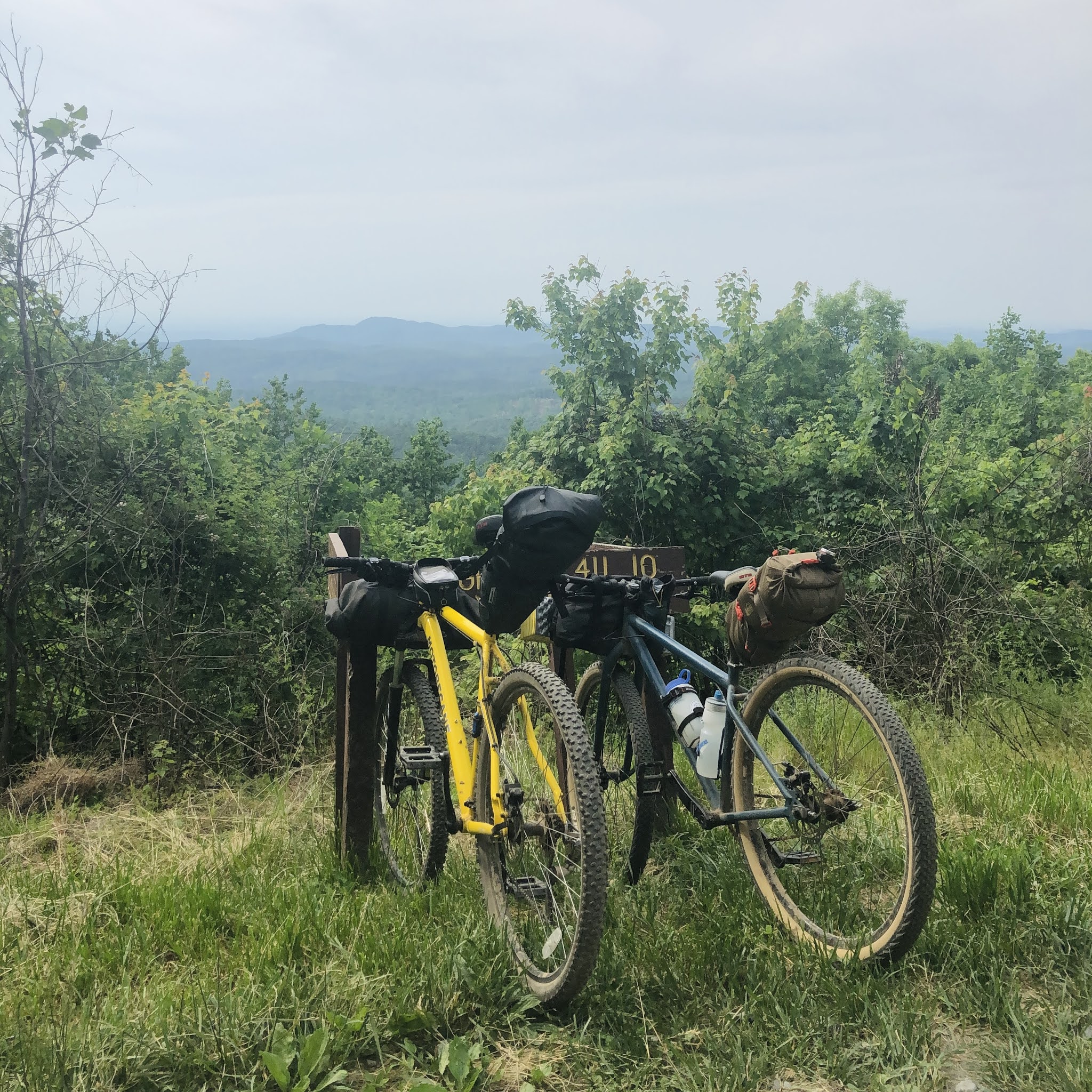
Less than a week after posting a blog titled, "The Art of Sucking It Up," I found myself sitting in the middle of a monstrous hill climb contemplating my existence and wondering if this was all worth it or not. Maybe not, but I did not want to keep going. When Max pitched the idea of riding the Cohutta Death March, I thought it would be hard but not that hard. As it turns out, this classic southern Appalachian gravel grind lives up to every bit of its name. I won't write a route description or trip report as many exist online, but you can watch an Instagram reel of our ride HERE. 

For the folks thinking about doing the route, I'll just say this: Max and I started at Cottonwood Patch Campground and did the loop counter-clockwise, which meant a 2,000 ft push condensed into just a few miles. This turned into a lot of hike-a-bike on my singlespeed, but even Max had to walk some of it. That said, I can't imagine doing this loop clockwise. I'd rather knock out the climb on West Cowpen Road the way we did and "coast" the back half (still a bit of climbing) instead of slogging up those gradual rollers and then squeezing my brakes the whole way back down to the valley. 


elevation profile for CW, we rode CCW 

Here's three things I learned while on the CDM: 
  1. Unless you want a raw tushy, do not sleep in sweat-soaked chamois. 
  2. Leftover pizza is the ultimate in bikepacking nutrition. 
  3. Max is a modern-day mystic; I think everybody should have a friend like him. In a world desacralized by modernity, Max still sees a world of mystery, meaning, and myth. Max inhabits, what Max Weber said of traditional societies, a “world that remains a great enchanted garden.” Everything is suffused and enveloped in import and our conversations demonstrated that. I think the way he reads the world is necessary and beautiful. He can also enter the Pain Cave with a Zen-like coolness that I am jealous of. I want to be a bit more like Max. 
the descents are hard-earned but fuuuuuuun 


Max

 Like this post? Continue to support megasplitter by subscribing to the mailchimp, commenting on, and sending the posts that you like to your friends.

Monday, May 17, 2021

The Art of Sucking It Up

*~SpRiNg BrEaK 2007~*

Have you ever woken up to a pack of raccoons tickling your feet? I have. I was 18 years old, camping on the eastern end of St. George Island with Russ. It was spring break and we were backpacking with our skimboards in tow. Two seniors in high school living on the beach for spring break? I had high expectations. I can't speak for Russ but I had envisioned the trip to be like hiking into the actualized lyrics of Katy Perry's "California Girls." But my eighteen-year-old brain vastly overestimated how many "daisy dukes, bikinis on top" would be hiking to a primitive backcountry campsite on the beach. The sum total was zero.

Instead, the trip went like this: Russ and I backpacked into a desolate campsite by the bay. It was cold. Sand filled every crevice of our bodies while sand gnats and mosquitos ravaged every exposed piece of our flesh. We wore makeshift burkas to shield our faces from the bugs. Even the skimboarding was bad. A couple of nights in, I forgot to hang our food and awoke under my tarp tent to a pack of raccoons tickling my feet, searching for treats. I got Russ up, packed our bags and hiked out. 

Some cherished memories happened that night, like hiking without headlamps by the starlight over the Gulf of Mexico (Russ told me years later, it was so beautiful he cried). But that doesn't change the fact that we gave up. We quit. When it got hard, we went home. That wasn’t the only time something like that happened either. In fact, Russ and I began making “a thing” out of hiking out in the middle of the night to find the nearest Waffle House. It was fun. But as I began to spend more time outside and the trips got longer and more remote, there weren’t any Waffle Houses to retreat to. Eventually, I had to learn the art of sucking it up.

You should read Haruki Murakami's What I Talk About When I Talk About Running. There's this line: “Pain is inevitable. Suffering is optional.” I think about that all the time when I'm out trail running or rock climbing because I have a choice in how I respond to pain and discomfort: give up or keep going.

Renowned psychiatrist, Viktor Frankl maintained that between stimulus and response, there is a space. And, “In that space is our power to choose our response.” Whether climbing mountains or running long distances, I think human-powered endurance activities help build the muscles used to make the responses required for suffering in the real world too.

Whether you’re running an ultramarathon and every muscle in your right foot is screaming...

Or you’re festering in a tent while bad weather batters your high camp... 

Or you’re working two jobs to pay off medical debt from a routine hernia surgery because Americans pay 40% more for healthcare than the rest of the industrialized world...

Each creates a space where the pain is inevitable but the suffering is optional. 

"Suffering," here, is the choice made to see it through. I don't mean this to romanticize or make light of anyone's actual physical, emotional, existential suffering. I think there's a difference between suffering and "things that suck." Yet it's all very subjective. And to be fair, navigating a pandemic, working an unsatisfying job, or arguing with a partner is not the same thing as trad climbing, ultra-running, or waking up to raccoons sniffing your feet. But the ability to take a deep breath, figure something out, and keep going when you're in the mountains might also help when you need to plan a budget, discuss your feelings, or finally find a therapist. 

Alpinist Kelly Cordes said of ultrarunners, "To keep going when given the option to quit is hardcore." If you're reading this then you made it through 2020 and you probably suffered something. We all learned a little about the art of sucking it up this year and I think we all got a little more hardcore. On a recent bikepacking adventure with Russ, I brought up that 2007 spring break trip. I talked about how thankful I was that playing outside taught us the same lesson running taught Haruki Murakami. Russ looked at me and spoke through the cloud of mosquitos and campfire smoke."It's funny you mention that," he said, "because I really wanted to call it quits today." We laughed and kept eating our ramen bombs and then we got back on our bicycles the next morning.

Like this post? Continue to support megasplitter by subscribing to the mailchimp, commenting on, and sending the posts that you like to your friends.


Saturday, November 16, 2019

The Birthday Challenge: THE ULTRA DADDY


This year was "Chet's Fourth Semi-Annual Birthday Challenge Bonanza" -- a number corresponding endurance objective to celebrate another trip around the sun. This year I ran my first ultramarathon, a 50K, or 31 miles for 31 years. No race. No medal. No t-shirt. Not even a bib number. Just a dumb idea I had about running circles in the woods. My good friend, climbing partner, and sufferfest connoisseur Josh ran Lookout Mountain's Big Daddy Loop three times with me -- THE ULTRA DADDY! 

Sidenote: I kind of burnt out on training and though I ran 13 trail miles pretty consistently, I never ran any more than that at a time. So everything I would experience after mile 13 was a mystery. Neat!

The first loop was legit fun. My wife Becca ran with us and it went by fast. I enjoyed listening to her and Josh talk about their nursing professions. We all felt really good, we ran at pretty good clip, and we had a really good time. Despite running in shorts I wore all throughout my training, I was experiencing some pretty bad chafing. Other than that, it was "Type 1 Fun."


My truck served as our "aid station" where Josh and I said goodbye to Becca then shoved some mini turkey wraps down our gullets, split a small can of Red Bull, refilled our water, dealt with our chafing issues and hit the trail again.


The second loop started off fun. Just the two of us, Josh and I talked about life and the meaning of life and social constructs and deconstruction and the appeal of Buddhism and so on and so forth. But somewhere around mile 17 or 18 we started talking more and more about what body parts were hurting the most. We made it back to the truck with stiff knees and high spirits and my sister-in-law Laura, her husband Max, and my sweet baby niece Ruby were in the parking lot.


Max joined us for the third loop, which was hell. It was tough to leave the comfort of my truck's tailgate and my right knee was really starting to yell at me but Max kept our spirits high. We were now running a little over a 14 minute mile which would devolve into a 15 minute mile and everything was a dull pain. At the marathon distance, however, Josh and I hit a wall. My right knee and my left foot were excruciating and my muscles were starting to really fatigue. The chafing that started in the first loop was starting to hurt again.


As we made the approach down toward the John Smartt trail ( a ≈ 1.7 mile uphill that gains ≈ 1,700 ft in elevation from the valley to the bluff) I was looking forward to my knees getting a "rest" going up. At Skyuka Spring we slammed some goo and made the now-ever-so-slow "speed hike" up the mountain. Of course, the rest was only a redistributing of pain from my knees to my quads.


At the crest of the bluff line, I was only 2 miles away from my Birthday Challenge goal and I was determined to "run" the rest of the way to 31. Those may be the hardest two miles of my life. Unfortunately, when we reached 31, we still had another two and a half miles to go before making the last turn downhill to the truck.

Somewhere, I remember Brendan Leonard (semi-rad.com) saying something about his goals for his next ultramarathon and wanting to "run most of the downhills." I remember thinking "the downhill? that's the easy part!" But that last 11 mile loop, I understood.

Each step downhill, no matter how small, felt like an actual endeavor in and of itself. We were passed by other runners and I wanted so desperately to protect my pride and tell them "this is our third loop!" or "we're on mile 28!" One pair of runners must have taken us for a trio of n00bs, asking us just a mile or so from the parking lot if we had headlamps because surely there was no way these two grandpas and one tall redhead would make it to their cars before dark!

Well, we didn't. But we did have headlamps. And when we got there, several friends were waiting, cheering us on and making a tunnel with their arms to run through. Josh and I cheers'd and exchanged hugs with folks before heading to Max and Laura's for pizza and ice cream. It was perfect. 


So very very very thankful for Rebecca who ran with us and planned the finish line and after party; Max who ran with us; Laura who drove up the mountain TWICE with baby Ruby (MVP!); Reid and Leah and Paul who showed up at the finish line to wish me a happy birthday; and to Josh who is always down to do hard things in the mountains with me. Next year, I think I'll go bouldering.

The ultra-daddy:


Saturday, March 30, 2019

The Birthday Challenge: 3,000 for 30


The birthday challenge is a number corresponding endurance objective. I've attempted a birthday climbing challenge three times before and have come up short that many times. When I turned 25 I attempted to climb 25 routes at the Obed but I got rained out. For my 27th birthday I attempted to climb 2,700 ft in a day but ran out of daylight. When I turned 30 last November I tried to climb 3,000 ft in a weekend -- my "El Cap birthday" -- but arrived at a cliff encased in ice and gushing with water. I felt cursed, dejected, and disappointed. As we hiked back to the truck Russ and I agreed to come back to Table Rock in March after his 30th birthday but I was not hopeful.

Table Rock hosts a slew of low grade multipitch which makes it a perfect candidate for high mileage objectives. Accessible grades can make for crowded Saturdays but the road to Table Rock was still gated off for the winter so we figured we could avoid some of the circus-like conditions by backpacking in via the Table Rock Gap Trail. This was my first climbing trip that required hiking in the tent, sleeping bags, food, water, and the rope and rack. We packed light and smart but it was still heavier than anything I ever carried as a backpacking guide.


late night start

We arrived at the Table Rock Gap trailhead at 12:30 AM and decided to hike up to the base of the cliff and camp that night. The TRG trail is steep, indeed very steep in places, but -- in my opinion -- beat the heck out of hiking up the paved road to Table Rock.


We woke up around 7:30 AM to powerful windy conditions that forced us to cook under the vestibule. A couple pouches of oatmeal and a shared cup of coffee later we hiked to the base of our first route -- Jim Dandy (5.4). Though we were alone at the campground we arrived at the route to find several climbers roping up ahead of us -- an Outward Bound guide training course. They promised a crowded cliff for the day and just like that, I perceived our goal already slipping away from us. However, they let us climb through and we managed to dodge them for the rest of the day. Huzzah!

Russ on the "Block Route"

Before lunch, and without any simul-climbing, we climbed 1, 500 ft. in sixteen-ish pitches using the three pitch Jim Dandy as our access point.
Jim Dandy + p3 of Cave Route AKA Block Route + Lightning Ledge Scramble (LLS)
Jim Dandy + K-Mart Special + LLS
Jim Dandy + My Route
My Route was exceptional. P1 takes off from the Lunch Ledge for 150 ft to a cozy belay. Small enough to feel the exposure, big enough to sit and dangle your legs over the abyss, with views of the rolling hills of western North Carolina --  if I were to create a Top 10 list of things that make me happy, belay ledges like this would be on there. Russ took p2 which holds the mental and possibly physical crux of the 5.6 route -- an airy move out from the roof of the dihedral to a slab. It's so good! Finally, p3 (the sixth pitch at that point) takes you to the summit proper for a fun ride.


a little tribute to Kyle Dempster

We escaped back to the tent for lunch -- tuna packets and tortillas and some instant "iced" coffee. Russ was feeling a bit disappointed that our objective felt so easy. I, on the other hand, who had hardly slept the night before, felt good but the sleepiness was creeping in.

The weather report gave us windy emojis and windy it was. Powerful and consistent gusts made the trees bend and move like those used car dealership inflatable tube men. (The nearest town recorded 27 mph winds.) But the eastern face of Table Rock had, thus far, guarded us from the gales. That is, until we climbed the North Ridge.

Russ coming up "My Route"

The North Ridge (5.5) sits on the northern nose of Table Rock and catches a lot of wind even on a non-windy day. The friendly wind emojis of the apple weather app felt like fierce hurricane like gusts at the base of the route. In all my years of climbing, though admittedly very little in the alpine, this was the windiest I have ever climbed in. It was wild. The rope blowing beneath me. My fingers entirely numb. Completely incapable of verbal communication with my partner. A few gusts felt like they might actually blow me off the wall. It was as full value as 5.5 gets and we were worked.

The last route of the day was a repeat of Jim Dandy to Block Route to the Lightning Ledge scramble and at this point, with all the miles of running and/or hiking in between routes, each high step on the slabs felt like the last set of lunges in the gym. I was wiped but by the end of the day we had climbed 2,270 of our 3,000 ft. objective.

bed time at Table Rock

Thursday night I probably slept a collective 2 hours. But Friday night, I crawled into my tent at 7:30 PM and didn't wake up until after 8:00 AM. We were less than 1,000 ft away from our goal and the next whole day ahead of us. But my body was feeling it. My quads were sore from the hiking and running. My calves were tight from the thousands of feet of slabbing. My back was wrecked by pulling and belaying hundreds and hundreds of meters of rope all day. The remaining routes would be no cake walk.

And they were not.

We started at Peek-a-Boo. Despite its mega-fun namesake move, the route had left a mysterious and bad taste in my mouth. The last time I climbed Peek-a-Boo was for my 27th birthday challenge. It was the route in which  the increased risk of simul-climbing registered in my mind and I also had gotten off route at some point and I didn't remember where.

It's worth mentioning at this point, and probably worth a separate post, that for the last year my lead head has been wonky. Sometimes some things just freak me out. I get inexplicably scared and problem solving and decision making take longer than usual. All this sounds rather silly when discussing a one-move-wonder 5.5 route, but it happened. And it happened worse than ever before. Elvis leg almost pushed me off the p2 traverse. The crux "peek-a-boo" move crippled me. At anchors I even forgot how to tie my clove hitch. At summit, unroped, I freaked out when Russ stepped closer to the edge than I would have liked him to. He snapped a loving but emphatic, "dude! what is wrong with you?" I had, and still have, an idea what was wrong with me but I didn't want to discuss it there nor do I want to write about it here.

Upon further inspection, Russ and I had done the 5.9 variation of the second pitch, which might have eased the embarrassment of my freak out but that had begun at the base of the route

Despite my uncharacteristic panic attack, pitches 1-2 of Peek-a-Boo is a wonderful climb. The third pitch however,  is a wandering, rope-draggy, licheny, forest fire scorched, vegetated horror-fest. If I could do it again, I would rap from the p2 anchors of Peek-a-Boo and swing over to the p2 anchors of Jim Dandy and run over to the Lunch Ledge to link up with My Route for a perfect day of classic and exciting 5.fun climbing.

Instead, we split p3 into two insufferable pitches which included a belay built -- as I found out -- in an ant bed. The thing tops out just to the right of the lightning ledge scramble and we made our way back down to our stash of water. We ditched the cams, packed a PBR, and more our way back to the east face.


Russ on p2 of "Jim Dandy" for 3756th time

This was it. One more trip up the mountain. We wanted to finish with My Route and lead the pitches we followed last time but a party was on it with a party behind them. And since another party was on Block Route as well, we decided to finish with K-Mart Special despite its high first bolt through a sea of crunchy and slippery lichen. "Whatever gets us to beer quicker," Russ said.

And we were off -- the last pitch of the day.

The mental exhaustion started to get even to Russ who seemingly just realized how much space was between the slab bolt and the fixed pin in the roof above. He placed a red C3 that walked out as soon as he moved above it. The objective he thought would be too easy was decidedly more difficult than he expected. The physical fatigue had really set in for both of us. Huffing and puffing each 5.6 move like it was a 5.12. I scarce remember a time of being so worn out.

And that's exactly it. We weren't pumped, we were exhausted from hiking with heavy loads; from not sleeping great; from running and hiking 1.5 miles between every route; from slabbing up Jim Dandy a trillion times; from pulling rope after every pitch; from belaying every pitch; from thinking through route finding and dehydration, and wind, and a panic attack. It was the exhaustion of collective of variables.  

As we coiled the rope at the Lightning Ledge and prepared to make our final scramble to the summit, I asked Russ if he thought finishing our goal would be anti-climatic. I don't really remember what he said but I think it amounted to "no."

I expected to crest the summit hooting and hollering, giving a resound "skee-yee!" as I often do when I clip the anchors of a proud send but there was no hooting and no hollering. There was only a solid high five, followed by a fist bump, and lastly a hug. We were done and it felt good. It was not an ecstatic finish as I expected but it was not the anti-climatic end I had wondered about a hundred feet below. Instead, it was the quiet contentment of accomplishing a long held goal with your best friend since second grade. And it doesn't really get any better than that. We shared the best tasting PBR I've ever had, asked a couple of hikers for a photo, and began our descent to our tent and finally to my truck. It really doesn't get much better than that. 

*fin


TL;DR
We used mountain project as our source for route lengths and figured the the Lightning Ledge Scramble to be about 100 feet. Ipso facto, Peek-a-Boo (400 ft.) + LLS (100 ft.) = 500 ft. If I could do it over again I would use another access route to the Lunch Ledge, like Cave Route besides Jim Dandy. I would rappel from p2 of Peek-a-Boo to Jim Dandy and link-up with My Route. And the MP forums have also informed me of a water source at Table Rock that would have eliminated hiking in so much water weight. Otherwise, it ruled.