Showing posts with label S24O. Show all posts

Sunday, July 3, 2022

How to Have a Microadventure

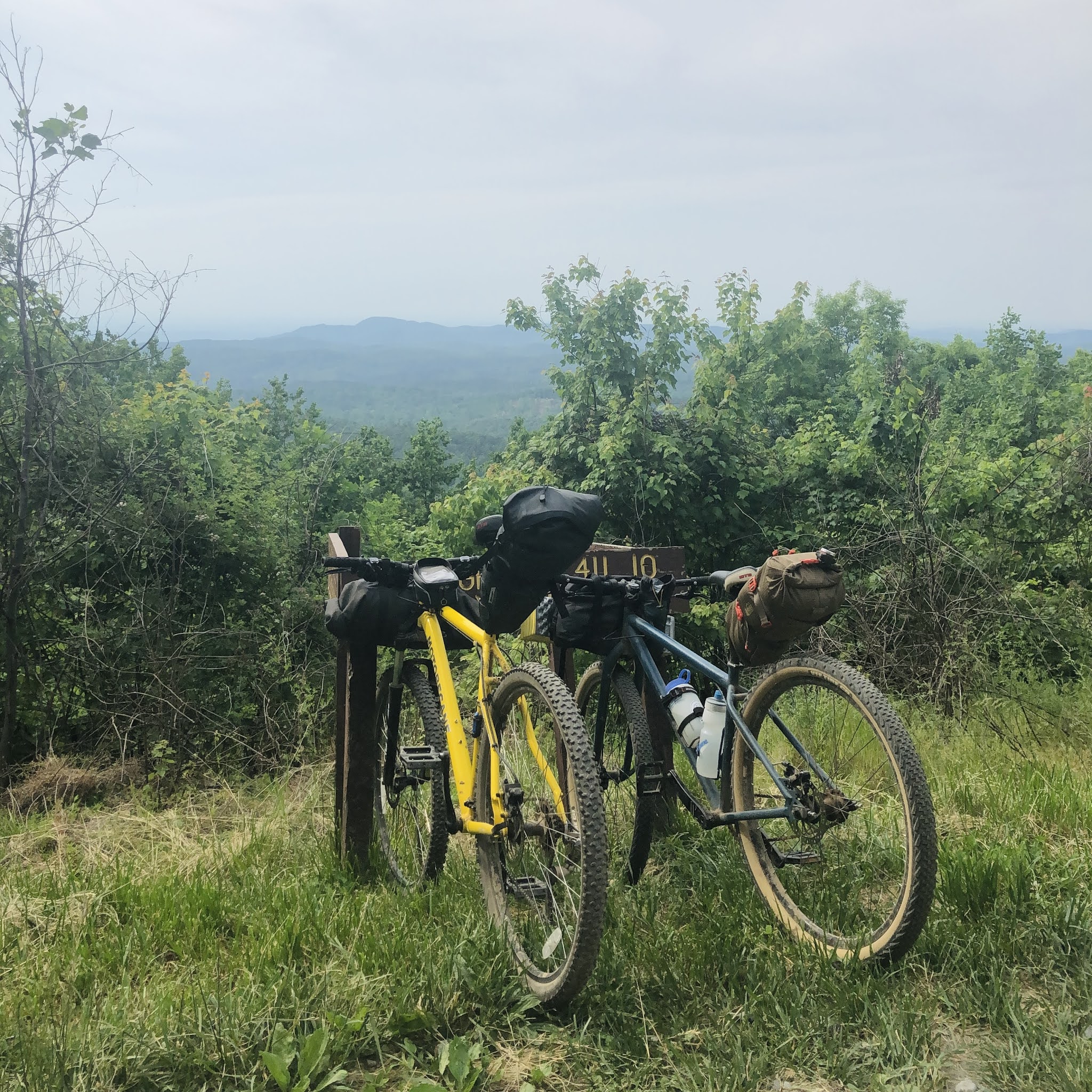
Lookout Mountain, Georgia

There are over three billion public land and marine acres in the United States. These are managed by a patchwork quilt of over 15,000 national, state, and local agencies and nongovernmental organizations. The overwhelming majority of these lands can be enjoyed by you and me. That’s amazing. 

Each of us owns our public lands, yet no single person can claim them as their own. It is this beautiful, (mostly) successful experiment in socialism that nobody knows about. At least 188 million acres of public lands are national forests, which operate under the multiple-use concept. This means you can basically do whatever you want out there so long as you preserve it for the next person. It’s that small “d” democratic spirit that Woody Guthrie sang about that makes our public lands so great.

The bicycle is a manifestation of that same spirit. The Nineteenth Amendment, which extended the democratic principle to women was ratified, in large part, because of the bicycle. According to Susan B. Anthony, the bicycle "did more to emancipate women than anything else in the world."  Google it. Bikes do not require a license or permit; anyone can ride one. Bicycling is possible for all ages, race and ethnicities, genders, and is generally accessible to all socioeconomic statuses. (Adaptive bicycles for riders with disabilities sadly remain a different story.) If you have a bike, you have cheap, clean, and healthy access to the world.


The bike is the people’s vehicle.

Public lands belong to the people. 

Together they foster a democratic spirit of adventure – the microadventure. Adventures, Alastair Humphreys says, for "normal people with real lives." Here's how to plan your own bicycle-powered microadventure. 


Pull up a map of your city. Print it off. Throw a dart at any of the green or brown areas and I bet you can ride your bike to it. There is a good chance you can sleep there as well. That is a microadventure. Don’t have a color printer or dartboard? Check out the Protected Areas Database from the United States Geological Survey. It is a national inventory of the United States' protected lands (and marine areas). 

One in every 3.5 acres of land in the United States is federally owned (i.e., you and me) but don't sleep on state parks and state forests (also owned by you and me) and benevolent private land managers. Chances are, wherever you live, there is someplace you can adventure to. 

Once you find a destination, you need a route. This, to me, is the fun part. I love maps. My wife estimates 90% of my non-work-related computer time is spent looking at maps. Several resources are available for planning the best possible route. I prefer unpaved adventures so I use gravelmap.com, mtbproject.com, and ridewithgps.com 

This particular route starts in Chattanooga and connects gravel, singletrack, and roads to Cloudland Canyon State Park on the Georgia side of Lookout Mountain. The route begins on trails managed by the Lookout Mountain Conservancy, the National Park Service, Georgia state parks, and various private landowners like Covenant College and Lula Lake Land Trust. That's a lot of bureaucratic cooperation in one overnight bikepacking trip. And it works! How neat is that? 


Except for the glaring little detail of how it was acquired from indigenous people, America’s public lands are among my favorite things about this urine-soaked hellhole. But the sordid history of land acquisition in the United States is not to be forgotten. There is one other map tool worth exploring when planning your microadventure: native-lands.ca  

Here you can discover what Native Americans or First Nations the land originally and rightfully belonged to. You can read about the territories and treaties and histories as well as visit the tribe's official pages. I suspect some readers will find this exercise performative SJW virtue signaling. Whatever. Native Land Digital tells indigenous histories on indigenous people's own terms and challenges non-indigenous people to learn about the lands we live on. As a social studies teacher and outdoor recreator, I think that matters. You might not. We all reserve the right to be wrong about everything and about this you would be. 

Cloudland Canyon State Park

Microadventures are democratic in the sense that they open up adventure to "normal" people. There is of course a degree of privilege -- the body you inhabit, the equipment you own, or the land you're on -- and the goal ought to be broadening the sense in which every person really can enjoy human-powered outdoor recreation and adventure. I think that bikes and public lands are a great place to start. 

If you live in Chattanooga and have a bike and sleeping bag, you can start here. The route is a mix of gravel, singletrack, and road. With a little bit of walking or guts, even the vintage, rigid, 26" mountain bike gathering dust in your parents' garage can do it. The entire route is on Cherokee and Yuchi land. Stay the night. Make some coffee. Reverse it back home or find one of the scenic highways to bomb back down to the valley. See you out there. 


*

 Like this post? Continue to support megasplitter by subscribing to the newsletter, commenting on, and sending the posts you like to your friends. 

Thursday, December 23, 2021

12 Months Sleeping Outside

Suck Creek Canyon and the Tennessee River Gorge

Sleeping outside is good for you. Evidence? Oh, so you’re Mr. Science Guy now. Here’s a sentence from the Journal of Environment and Behavior that’ll make you absolutely want to scrape your eyeballs out: 

“Analysis revealed a positive, linear association between the density of trees and self-reported stress recovery, adjusted R2 = .05, F(1, 149) = 8.53, p < .01.” 

STEM ruins beauty. Compare that to this poem by Wendell Berry:

"I go and lie down where the wood drake rests in his beauty on the water, and the great heron feeds. I come into the peace of wild things who do not tax their lives with forethought of grief. I come into the presence of still water. And I feel above me the day-blind stars waiting with their light. For a time I rest in the grace of the world, and am free." 

I spent the year trying to regularly, once a month, rest in the peace of wild things and it was liberating. This dumb little goal helped me feel a lot more like myself but I have no evidence to prove it and also I'm no poet. So here's some beauty-ruining data and crappy iPhone photos from a year of sleeping outside once a month. 


Figure 1

I did not sleep outside in February or August. Mid-February, Rebecca and I took our first trip away since the pandemic started. Ultimately, because of COVID restrictions, we really just did the same thing we do in Chattanooga, except in a cabin in the woods. We went for hikes, watched T.V., got dinner out, brought it back to the house, and ate. R.V. people call that "camping" so it's on the list but is not included in the subsequent data. August is just terrible and I didn't even try to sleep outside. Who cares? Not me. 

I wrote trip reports for a few of these, which you can read HERE

Russ vintage mountain bike-packing through north Florida pine forests


Figure 2

Ten out of 11 trips were with friends. I think that speaks for itself. I also appreciate the variety of folks I was able to share these spaces with; ranging from my life-long best friend, Russ to Reid and Leah and their one-year-old daughter. Max and Brooks take the cake for most trips (Max was part of the King Family Campout). 


Max riding out of the fog in Prentice Cooper State Forest


Figures 3.a and 3.b

Getting outside doesn’t have to be complicated. “Aim small, miss small.”80% of these monthly adventures were overnighters within an hour or two of home. This is pretty easy in a town like Chattanooga and I'm thankful for that. But I think that a lot of us can find these small adventures near our respective towns. 


adventure from the front door somewhere on Lookout Mountain


Figure 4

83% of nights slept outside were on public land. Public land conjures images of dense forests and spacious deserts managed by the US Forest Service or  Bureau of Land Management but let's not forget about our state parks! State parks get a bad rap, I think, because, well honestly, they can be bougie and touristy and feature things like zip lines and golf courses. But some of our iconic outdoor spaces are our state parks: Eldorado Canyon in Colorado or Cloudland Canyon in Georgia. What incredible resources we should protect. 


Becca overlooking Savage Gulf at the South Cumberland State Park


Figure 5

2021 was the year of bikepacking. This was by design as part of the reason I set this goal was to bikepack more. A note on the "other:" this includes car-camping with Rebecca's family and sleeping in my parent's backyard. 

all that bikpacking and only one flat...


Figure 6


I slept outside for years, months at a time even, without owning a tent. Cowboy or cowgirl or cowperson camping is the purest form of sleeping outside and it’s in my blood. I finally bought my first nice tent back in 2018 and I got some good use out of it this year but I still prefer no separation between me and the open air. Again, I want to emphasize the point that camping doesn't have to be complicated. Camping tentless is lighter, simpler, and in my opinion, better. 


Brooks cowperson camping in Suck Creek Canyon

*

 Like this post? Continue to support megasplitter by subscribing to the newsletter, commenting on, and sending the posts you like to your friends.  


Wednesday, May 26, 2021

BONUS: The Cohutta Death March (S24O)

viewpoint midway up Cowpen Road

Less than a week after posting a blog titled, "The Art of Sucking It Up," I found myself sitting in the middle of a monstrous hill climb contemplating my existence and wondering if this was all worth it or not. Maybe not, but I did not want to keep going. When Max pitched the idea of riding the Cohutta Death March, I thought it would be hard but not that hard. As it turns out, this classic southern Appalachian gravel grind lives up to every bit of its name. I won't write a route description or trip report as many exist online, but you can watch an Instagram reel of our ride HERE

For the folks thinking about doing the route, I'll just say this: Max and I started at Cottonwood Patch Campground and did the loop counter-clockwise, which meant a 2,000 ft push condensed into just a few miles. This turned into a lot of hike-a-bike on my singlespeed, but even Max had to walk some of it. That said, I can't imagine doing this loop clockwise. I'd rather knock out the climb on West Cowpen Road the way we did and "coast" the back half (still a bit of climbing) instead of slogging up those gradual rollers and then squeezing my brakes the whole way back down to the valley. 


elevation profile for CW, we rode CCW 

Here's three things I learned while on the CDM: 
  1. Unless you want a raw tushy, do not sleep in sweat-soaked chamois. 
  2. Leftover pizza is the ultimate in bikepacking nutrition. 
  3. Max is a modern-day mystic; I think everybody should have a friend like him. In a world desacralized by modernity, Max still sees a world of mystery, meaning, and myth. Max inhabits, what Max Weber said of traditional societies, a “world that remains a great enchanted garden.” Everything is suffused and enveloped in import and our conversations demonstrated that. I think the way he reads the world is necessary and beautiful. He can also enter the Pain Cave with a Zen-like coolness that I am jealous of. I want to be a bit more like Max. 
the descents are hard-earned but fuuuuuuun 


Max

 Like this post? Continue to support megasplitter by subscribing to the mailchimp, commenting on, and sending the posts that you like to your friends.
Monday, February 15, 2021

On the month of January, fire guys, and clearcuts

 
bikepacking in Prentice Cooper State Forest

I decided to keep my 2021 new year's "resolution" very conservative: sleep outside once a month. Many of these nights outside will come in the form of "microadventures."The New York Times described microadventures as "short, perspective-shifting bursts of travel closer to home." These little write-ups will serve to dicument those shifts in perspective.

On microadventure #1

Max and I bikepacked to Davis Pond campground in Prentice Cooper State Forest. We met our friends Reid and Josiah who backpacked in on the Cumberland Trail. It was a dreary day but the clouds parted long enough for a nice sunset and long campfire before the floodgates of heaven were released. It was a cold, wet, and really good time.

On the month of January

January is the month equivalent of the state of Ohio. "Ohio," of course, being Native American for a shoulder shrug. Nobody cares about Ohio outside of elections. Nobody loves January except for the first day of month and even that's about the last day of December. The initial high of New Years and its resolutions quickly wear off in the month's cold, wet, dark days. The holidays are over and everybody's exhausted and broke. The joy of fall and the hope of summer are equidistant goal posts from these, the doldrums of winter. No wonder more people die in January than any month. I used to like January for its prime Southeastern climbing conditions but the more and more I ride my bike the more and more I long for warmer days. Thank God February is our shortest month.

On campfires 

I love looking at fire. My friend Reid wrote a while back, "Around a fire, the lulls in conversation that sometimes sandbag the whole affair are changed into pleasant meditations. There’s nothing to say, but there is a fire to look at." But I don't need a lull to stare. In fact, I don't say much around the campfire (this is my modus operandi at most social gatherings). Instead, I sit listening to the conversation around me; soaking it all in. The lull is the brief moment in time in which I insert myself through a joke, anecdote, or factoid before retreating back to my warm cocoon of silence, looking at the fire, listening to the sounds. 

campfire at Davis Pond campground
 

In defense of the "fire guy" 

We all know a "fire guy:" the guy who tends to the fire throughout the night with the eagerness of a boy scout and is often derided as such. The fire guy gives off strong "eager beaver" vibes. They meticulously build tiny twig tee-pees. They tend to the small sparks with motherly care until their baby fire grows into a roaring flame. They get down on all four and they huff and they puff at the coals. They snap sticks over their knees. They tweak and they poke and they prod at the fire all night long. They seldom sit. And all the while we benefit from their action. We sit and drink and laugh and converse never minding the intense labor of love that is taking place before our eyes. We are the birds on the elephant's back. The elephant is neither helped nor harmed but the birds eat their fill and enjoy their lives. Max was our elephant and what an elephant he was! All hail, "fire guy."

On clearcutting

clearcuts along Tower Road

Clearcutting is the harvesting of an entire stand of trees in a single operation and leaves behind a post-apocalyptic hellscape. Dig a trench, add some barbed wire, throw in a horse wearing a gas mask, and a clearcut looks like every picture of World War I you’ve ever seen. The gravel ride along Tower Road passes many such atrocities.

Much of the plateau in Prentice Cooper is subject to logging prescriptions that involve clearcutting and — I cannot decide if this is shocking or not — Tennessee has no statutes regulating the quality of this high-intensity timber harvesting. The Forest Service intends that these clear cuts are re-established but as Janisse Ray says in Ecology of a Cracker Childhood, "there is no way to re-create a forest. Not quickly. And the trees will just be cut again." The replanted stand of trees near Davis Pond campground is typical of these "re-created" factory forests: systematic rows of identical trees more reminiscent of a plantation than a forest.

Clearcutting destroys biodiverse forests, accelerates climate change, contaminates watersheds, depredates healthy soils, and decimates native plant species. Monitoring already shows a drastic decline in biodiversity in Prentice Cooper. Oak and hickories fail to regenerate in the degraded soil and only poplar and invasive autumn olive remain. The volume of cutting is increasing and clearcutting is becoming the norm.

But why should I care? I mean, I still use toilet paper to wipe my butt*. I am an imperfect conservationist. But I do think that trees and forests have intrinsic value beyond unsustainable market mechanisms. "The trees encountered on a country stroll, reveal a lot about a country's soul," wrote W.H. Auden. And I fear for our country's soul for so many reasons.  

FURTHER READING:

*Toilet paper wipes out 27,000 trees a day.  (National Geographic)
Tennessee Heartwood (Tennessee state forest advocacy group)
Gospel of the Trees curated by Alan Jacobs

Monday, December 7, 2020

On bikepacking, n00bs, and Confucius

photo by Gray

My quads screamed for those who could hear them. I brought only one water bottle and it was empty. My body was dehydrated, my bike was heavy, and the hills were steep. I bonked and I bonked hard. My friends were far ahead of me and I felt something I hadn't felt in years: I was a beginner again...

I’ve spent the last several years as a teacher: teaching kids how to backpack, make fires, and set camp or showing friends how to tie knots, place cams, and build anchors. My job is literally to teach students about United States Government and economics. My Enneagram type, for whatever that’s worth, is “the investigator” or some astrology-for-post-evangelicals-BS like that.

It’s true, I do like to know things. I like to be the guy explaining elections by drawing median voter hypothesis graphs on napkins at bars. I don’t like not knowing things. It makes me feel inadequate and dumb. I'm working on that particular character trait but I still don’t like being a beginner. Does anyone? The internet developed new slang for the beginner: "n00b," "newbie," "nub." We have social media accounts dedicated to making fun of surfing “kooks,” rock climbing “gumbies,” and snowboarding “jerries.” We, myself included, glaringly judge the inexperienced and the novice even though we were all, at one point, both.

I don’t know what beginning bikebackers are called but I am one. A few months ago, I went on my first S24O and I looked like an absolute goober. I had gear strapped to my basket like my bike was an 1840s prospector’s mule and I lost my Black Diamond bivy bag because of it. When my only water bottle was empty before a sustained seven-mile climb, and my entire body decided to call it quits, I felt like an absolute goober too. I felt weak, unprepared, and dumb.

I was a n00b.

Being a beginner is humbling and humility isn’t necessarily an innate characteristic. It's a virtue. And we have to be schooled in it. Humility contradicts our notions of self-esteem and self-confidence -- the ego. In the West, learning, which implies some degree of ignorance, is for establishing the learner as right or correct which is quite a static thing. In Confucianism however, humility removes obstacles that stand in the way of self-cultivation, which is much more dynamic. The learner is never finished with the learning. Confucius warns about the trap of conceit and certitude and instead appeals to the constant need for self-cultivation. Which is to say that when we admit we don’t know everything, we can learn many things. Which helps us grow individually and communally and develop a richer and more meaningful life.

My friend Reid is a runner. Last year, after my first (and only) 50K, Reid said something about how he could never do something like that but now he is. In less than a year, Reid has already run a handful of half marathons, one of Chattanooga’s premier trail races, and his eyes are set on an ultra-marathon. Every weekend, I look forward to checking Strava to see what new goal he’s crushed or PR he's set. Reid became a beginner, though it wasn’t without awkwardness or pain. Reid told me once of turning a corner at full tilt and running straight into a stop sign. But he did it and he continues to do it and that’s so dang rad.

My mom started playing guitar in her fifties and even though she was not particularly excited to play in a recital where she was four decades the senior of the other performers, she did it. Their home is filled with music now. My dad has been reading a lot of books on race and justice and political imagination and a month ago, over a family Zoom bookclub he said, with tears in his eyes, “I’m throwing out everything I ever grew up thinking.” Being a beginner is tough and humbling and sometimes even humiliating. But I think my mom, my dad, and Reid would say that their lives are better, richer, and more meaningful because they were willing to begin again.

Confucius taught that humility prepares us to practice other virtues that make life richer. I don't know where exactly bikepacking falls into all that but I think it does. When I look back at those pictures of my first S24O and my poorly packed bike and my goofy climbing helmet and the healthy dose of humble pie as I walked my bike up the monster hill to see my new friends waiting on me and I think about how much joy and meaning riding my bike in the woods has brought me this past year and I am grateful. 

In a year when so many people have retreated to the outdoors to find joy and peace of mind, there's a lot of n00bs out there. I am one of them. And so were you. So let's be gentle and celebrate those new beginnings. Confucius would.

 
leaving pavement
 

updating Stravas (photo by Gray)
 
 
morning views


packing up
 

camping spot

bombing hills

helping friends

Like this post? Continue to support megasplitter by subscribing to the mailchimp, commenting on, and sending the posts that you like to your friends.