Wednesday, May 26, 2021

BONUS: The Cohutta Death March (S24O)

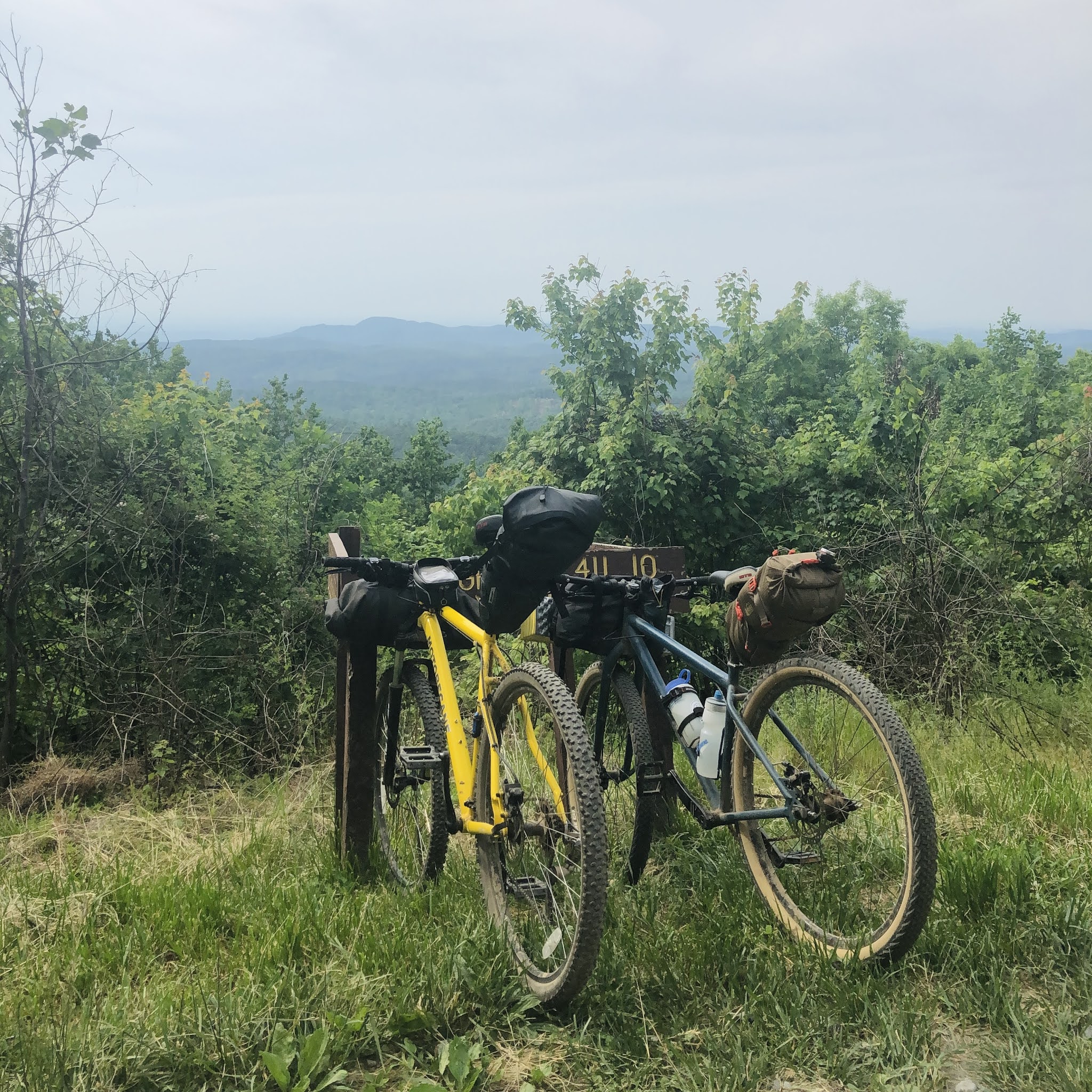
viewpoint midway up Cowpen Road

Less than a week after posting a blog titled, "The Art of Sucking It Up," I found myself sitting in the middle of a monstrous hill climb contemplating my existence and wondering if this was all worth it or not. Maybe not, but I did not want to keep going. When Max pitched the idea of riding the Cohutta Death March, I thought it would be hard but not that hard. As it turns out, this classic southern Appalachian gravel grind lives up to every bit of its name. I won't write a route description or trip report as many exist online, but you can watch an Instagram reel of our ride HERE

For the folks thinking about doing the route, I'll just say this: Max and I started at Cottonwood Patch Campground and did the loop counter-clockwise, which meant a 2,000 ft push condensed into just a few miles. This turned into a lot of hike-a-bike on my singlespeed, but even Max had to walk some of it. That said, I can't imagine doing this loop clockwise. I'd rather knock out the climb on West Cowpen Road the way we did and "coast" the back half (still a bit of climbing) instead of slogging up those gradual rollers and then squeezing my brakes the whole way back down to the valley. 


elevation profile for CW, we rode CCW 

Here's three things I learned while on the CDM: 
  1. Unless you want a raw tushy, do not sleep in sweat-soaked chamois. 
  2. Leftover pizza is the ultimate in bikepacking nutrition. 
  3. Max is a modern-day mystic; I think everybody should have a friend like him. In a world desacralized by modernity, Max still sees a world of mystery, meaning, and myth. Max inhabits, what Max Weber said of traditional societies, a “world that remains a great enchanted garden.” Everything is suffused and enveloped in import and our conversations demonstrated that. I think the way he reads the world is necessary and beautiful. He can also enter the Pain Cave with a Zen-like coolness that I am jealous of. I want to be a bit more like Max. 
the descents are hard-earned but fuuuuuuun 


Max

 Like this post? Continue to support megasplitter by subscribing to the mailchimp, commenting on, and sending the posts that you like to your friends.

Monday, May 17, 2021

The Art of Sucking It Up

*~SpRiNg BrEaK 2007~*

Have you ever woken up to a pack of raccoons tickling your feet? I have. I was 18 years old, camping on the eastern end of St. George Island with Russ. It was spring break and we were backpacking with our skimboards in tow. Two seniors in high school living on the beach for spring break? I had high expectations. I can't speak for Russ but I had envisioned the trip to be like hiking into the actualized lyrics of Katy Perry's "California Girls." But my eighteen-year-old brain vastly overestimated how many "daisy dukes, bikinis on top" would be hiking to a primitive backcountry campsite on the beach. The sum total was zero.

Instead, the trip went like this: Russ and I backpacked into a desolate campsite by the bay. It was cold. Sand filled every crevice of our bodies while sand gnats and mosquitos ravaged every exposed piece of our flesh. We wore makeshift burkas to shield our faces from the bugs. Even the skimboarding was bad. A couple of nights in, I forgot to hang our food and awoke under my tarp tent to a pack of raccoons tickling my feet, searching for treats. I got Russ up, packed our bags and hiked out. 

Some cherished memories happened that night, like hiking without headlamps by the starlight over the Gulf of Mexico (Russ told me years later, it was so beautiful he cried). But that doesn't change the fact that we gave up. We quit. When it got hard, we went home. That wasn’t the only time something like that happened either. In fact, Russ and I began making “a thing” out of hiking out in the middle of the night to find the nearest Waffle House. It was fun. But as I began to spend more time outside and the trips got longer and more remote, there weren’t any Waffle Houses to retreat to. Eventually, I had to learn the art of sucking it up.

You should read Haruki Murakami's What I Talk About When I Talk About Running. There's this line: “Pain is inevitable. Suffering is optional.” I think about that all the time when I'm out trail running or rock climbing because I have a choice in how I respond to pain and discomfort: give up or keep going.

Renowned psychiatrist, Viktor Frankl maintained that between stimulus and response, there is a space. And, “In that space is our power to choose our response.” Whether climbing mountains or running long distances, I think human-powered endurance activities help build the muscles used to make the responses required for suffering in the real world too.

Whether you’re running an ultramarathon and every muscle in your right foot is screaming...

Or you’re festering in a tent while bad weather batters your high camp... 

Or you’re working two jobs to pay off medical debt from a routine hernia surgery because Americans pay 40% more for healthcare than the rest of the industrialized world...

Each creates a space where the pain is inevitable but the suffering is optional. 

"Suffering," here, is the choice made to see it through. I don't mean this to romanticize or make light of anyone's actual physical, emotional, existential suffering. I think there's a difference between suffering and "things that suck." Yet it's all very subjective. And to be fair, navigating a pandemic, working an unsatisfying job, or arguing with a partner is not the same thing as trad climbing, ultra-running, or waking up to raccoons sniffing your feet. But the ability to take a deep breath, figure something out, and keep going when you're in the mountains might also help when you need to plan a budget, discuss your feelings, or finally find a therapist. 

Alpinist Kelly Cordes said of ultrarunners, "To keep going when given the option to quit is hardcore." If you're reading this then you made it through 2020 and you probably suffered something. We all learned a little about the art of sucking it up this year and I think we all got a little more hardcore. On a recent bikepacking adventure with Russ, I brought up that 2007 spring break trip. I talked about how thankful I was that playing outside taught us the same lesson running taught Haruki Murakami. Russ looked at me and spoke through the cloud of mosquitos and campfire smoke."It's funny you mention that," he said, "because I really wanted to call it quits today." We laughed and kept eating our ramen bombs and then we got back on our bicycles the next morning.

Like this post? Continue to support megasplitter by subscribing to the mailchimp, commenting on, and sending the posts that you like to your friends.


Sunday, May 2, 2021

The 5 Worst Kinds of People at the Crag

Josh at an empty crag near Chattanooga

It's hard to have the crag to yourself these days. That's okay. But there's no denying that our cliffs and boulders are seeing more people than ever before and climbing's ever-growing popularity has changed the landscape of the sport, sometimes literally. I'm increasingly and un-inronically convinced that the most ecologically responsible thing a climber can do is quit climbing. But nobody's going to do that. So whether you're headed to Ten Sleep or the New River this summer, there are lots of climbers out there and there's some that you should avoid and avoid being like.

5. The Bluetoothers & Hammockers

There are worse people on this list but the Bluetoothers and Eno Hammockers are my personal least favorite. These easy to spot (and hear) user groups are likely young granola types from the local university's outdoor club and they treat the outdoors like their campus's green space: bright colored hammocks strewed about with electronic toilet-noise music blasting loudly. Nobody likes your music. Nobody likes mine either. This is a forest/cliff/desert/mountain, not a chill hang-out spot to vibe with your friends. Leave your boombox and hammocks at home.

4. The Screamers & Wobblers

One time, my friend Julia and I went to the Obed for a day trip with a couple from Nashville. Julia and I were not a couple. In fact, I spent the whole drive talking about my friend Eli and now Julia and Eli are married (a point I did not neglect to mention when I officiated their wedding). Both members of that couple were strong climbers with even stronger personalities. They spent the entire day arguing about route choice, screaming about beta differences, yelling at each other about belay catches, and throwing humongous hissy fits when they did not send. Except for Julia, I never climbed with those people ever again. 


I understand being frustrated with bad climbing or bad belaying or obnoxious beta spraying but yelling, fit pitching, and temper tantruming (otherwise known as a "wobbler") is inexcusable behavior when other people are at the cliff. 


I also find screaming while trying hard a particularly annoying crag occurrence. There is some evidence that it helps with the send but it is really about the short, powerful exhalation -- not the noise. My friend Josh is a great example of a strong climber who exhales with purpose, rather than screams like a banshee. Noise pollution comes in many forms. Keep it down...

Cora and Josh being good land users AAA Crag in the U.P. Michigan

3. The Sandbaggers & Beta Sprayers

Everybody knows these guys -- usually guys -- and the Venn-Diagram of sandbaggers and beta sprayers is quite large. Sandbaggers undersell the difficulty of an objective while Beta Sprayers give unsolicited advice about how to accomplish the objective. Maybe you have had a conversation like this:

me: hey, we're looking for [5.8 hand crack in a dihedral].

Sandbagger: oh, you should totally get on this [5.10c overhanging splitter finger crack]

or like this: 

me: *falling off difficult-for-me boulder problem and not asking for help*

Beta Sprayer: bro! you gotta hand-heel match, then cross, then throw for the lip!

Both, Sandbagger and Beta Sprayer, are so plagued by their own ego that they feel the need to spray or "word vomit" all the information and not-so-humble brag they can muster to anyone in earshot. Everybody begrudgingly listens but nobody actually likes them. Don't be one of them.

2. The Non-Hole Digging or Wagbagging Woods Poopers

I'm not quite a crusty trad-dad yet, but I have been climbing long enough to see how climbing's growing popularity has caused growing pains at our local crags. Nothing demonstrates this more than the proverbial minefields of human feces that surround our most popular cliffs. I haven't climbed at Foster Falls in years (I refuse to anymore), but even a few years ago you couldn't wander into the woods to pee without stumbling on, what the Access Fund calls, "toilet paper flowers." AKA "flowers" or piles of soiled toilet paper erupting from the earth. Do we even need to talk about how reprehensible this is? 

It's gotten so bad that WAG-bags -- special bags you poop in and carry out -- are being implemented at southeastern crags, like Deep Creek. These bags were once reserved for delicate desert and alpine environs but increased use and impact at southern climbing destinations has necessitated them. Fun.

1. The Dangerously Stupid Help Rejecters

I watched a climber deck at Horseshoe Canyon Ranch. It was from the first bolt so it wasn't as bad as it could have been but I'm pretty sure he was going home with bruised or broken heels that evening. After we checked on him, to our dismay, he started up the route again! This time, when he struggled at the first bolt, he put his finger through the hanger in desperation. We let out a collective, "NOOOO!" and offered to spot him for a downclimb and let us stick clip it, if he was still committed to the route. He rejected our help and we packed up and hightailed out of there because we didn't want to scoop up brains that afternoon. 

We were all gumbies at some point. I had a few helpful mentors along the way but I am very much a self-taught climber. I've built anchors I'm ashamed of and I've done things that have caused me traumatic flashbacks about how I could have died or severely injured myself. One thing I've always appreciated is when a more experienced climber offered me a teaching moment in a kind, helpful way. 

Pride, ego, and insecurity combined with stupidity is a dangerous concoction. Be humble. And when the visibly ignorant are openly recalcitrant, it's probably just best to pack your gear and move on.

Like this post? Continue to support megasplitter by subscribing to the mailchimp, commenting on, and sending the posts that you like to your friends.

Monday, April 19, 2021

On the Moka Pot: A Meditation in 4 Parts

Ten Sleep Canyon, Wyoming
 
First, a story:
I remember the morning alpenglow on the limestone walls of Ten Sleep Canyon, the cool air, and the wildflowers scattered throughout the meadow.  Or maybe it was the morning wind blowing through the piƱon pines of El Rito, New Mexico's high desert? I can't remember the place. But I do remember the dull roaring of a Bialetti moka pot precariously situated above a pocket rocket stove and the rustling of a waking Josh from his tent. That morning, like every morning, I'd pour Josh a cup of addictive legal stimulant.
 
All summer Josh commented about my coffee, which was strong, dark, and viscous. It was the kind of coffee your machismo uncle said, “would put hair on your chest.” Josh sipped the velvety dark brew, shuddered, and then stared, bewildered, as I unhesitatingly guzzled it down. 

Making moka pot coffee was my morning routine for years both at home and in the woods. But that morning in Wyoming or New Mexico or possibly Colorado, I mentioned that I had always been confused about my beloved coffee gadget. It was marketed as a “six cup” stovetop espresso maker but each brew barely filled one coffee mug; what was the deal? Josh, still in his sleeping bag and a fresh cup warming his hands, began to laugh as he put it all together in his head. “Six espresso cups,” he chortled. “Chet, you’ve been drinking six servings of espresso every time you use this thing.” 
 
That would explain the jitters and my long love affair with big, bold, and borderline bitter coffee.
 
 
Now, a clarification:
The moka pot does not make actual espresso. There's not near enough pressure. However, it is still quite strong, it makes a kind of "crema," and is a worthy working-class simulacrum. And if it’s good enough for a 60.36 million Italians, it’s good enough for you. 

Then, a haiku:

black blood of the earth
trickling downward the altar
life unto the world


And finally, a recipe:
This recipe is inspired by Velo Coffee's Americano, which pushes the espresso shot through an Aeropress. The double paper filtration removes the bitterness but keeps the robustness that the moka pot is known for. It produces a strong but smooth cup of coffee that will supercharge your Monday.
  1. Grind the beans somewhere in between espresso and drip; more coarse means less bitter. Brighter and lighter coffees work nicely but avoid the extra fruit-forward stuff. I like espresso roasts but avoid the big box store, pre-ground kind. If you live in Chattanooga, Velo Coffee Boneshaker is my absolute favorite coffee roast. So dang good. 
  2. Brew the coffee in the moka pot. This Reddit user has provided a Moka Pot Master Guide; I wholeheartedly recommend using it. The three following bits are crucial: (a) boil the water before pouring it into the base (b) use a knife, finger, or Aeropress paddle to level the coffee with the lip of the basket but don't pack it down! (c) adhere a rinsed Aeropress filter to the gasket of the upper chamber.
  3. Cool the bottom half of the moka pot in cold water (in a bowl or under the tap) immediately after the coffee has gurgled its way into the upper chamber. This prevents the beans from "cooking."
  4. Pour the brewed coffee into an Aeropress as you would using the standard brewing method (upright and unturned).
  5. Plunge slowly. This is a good rule of thumb for all Aeropress recipes but especially so here. Be particularly mindful as you near the bottom of the chamber. Since the only thing in the chamber is liquid there is not much resistance. Press too fast and extremely hot liquid will spew out the air vents in the bottom of the Aeropress.
Dang, I can barely write this without getting giddy. Give it a taste and let me know what you think!

Like this post? Continue to support megasplitter by subscribing to the mailchimp, commenting on, and sending the posts that you like to your friends.

Monday, April 5, 2021

Bikepacking Florida's "Tour de Pines"

pines and palmettos, FR-309

I. Homesickness

I left my parents' home ten years ago this summer. My mother says she knew when I left Florida that I’d never come back and so far she’s been right. The Cumberland Plateau, the southern Appalachians, and the city of Chattanooga — they feel like home now. That is until I drive south and begin to see the trees. Something happens in my body when I see the dense forests of yellow pines and canopies of moss-filled oaks — something mysterious, perhaps even mystical. It’s as if the trees of the field are reminding me that no, this is home.

About a year ago, I began to feel homesick. I had not made that drive in some time and the pandemic would not permit me to make it for another while. I was reading Janisse Ray’s lovely Ecology of a Cracker Childhood and leaning heavily into “adventure biking” when I watched a full 50-minute POV video of the “Gravel Cyclist” riding the red clay roads from my hometown (Tallahassee, Fl), to Thomasville, Georgia, where my sister now resides. I began dreaming of bikepacking around where I grew up and continued to do so for an entire year.

I poured myself over maps, I stalked Instagram location tags and strangers’ Strava rides, and I put together a three-day “Tour de Pines” around north Florida’s gulf coast. And even though he didn’t own a bike, I coaxed my life-long best friend and adventure partner, Russ to do it with me. A week before the trip, he bought a 1985 Nishiki vintage 26” MTB off Craigslist and we were “good” to go.

II. The Trees

It would be easy to assume, as many do, that because of their flatness, the coastal plains of north Florida are monotonous and prosaic. To be fair, they appear this way from the window of a passing car headed to the white sandy beaches of the Gulf of Mexico. However, within the belly of the forest are some of the most biodiverse ecosystems left in North America: sandy flatlands and wiregrass habitats, federally protected titi swamps and longleaf pine savannas, and both salt and freshwater marshes full of fish, ibis, ospreys, eagles, and alligators. Lots of alligators.

FR-350

Loblollies surrounded my parents’ home. Southern yellow pines, like the loblolly and longleaf, are tall elegant trees that support the kinds of aforementioned bio-diverse ecosystems in the deep south. The thick branches grow high and create a rounded crown of green foliage whose queenly majesty reminds me of my paternal grandmother. I remember her long-legged, distinguished, and full of life as well. Amidst their roots, my roots are planted deep. Beneath their canopies, I came of age. That is, I grew up, like the saw palmetto and the red-cockaded woodpecker, in the shadow of the loblolly, longleaf, and shortleaf pine.

I didn’t read many of the books I was supposed to in grade school. But I did read The Yearling by Marjorie Kinnan Rawlings. I don't remember much about it except that it's about a boy named Jody, born to settlers in the Florida backcountry. But I do remember the landscape; the “Big Scrub” topography which was portrayed as if it were a character itself, the way Cormac McCarthy does, but for kids. The scrub was an unforgiving and excoriating landscape. I guess my boyish self could read and remember The Yearling because it felt like I was reading my parents' backyard where I built forts, made believe, and caught crawdads in the creek among the towering pines and thickets of palmettos just like Jody.

Newport Campground

I thought about The Yearling and Ecology of a Cracker Childhood a lot on this ride. The Florida wilderness is every bit as harsh and as beautiful, albeit in its peculiar ways, as anywhere else I’ve been in the United States. I thought about the indigenous peoples these lands rightfully belong to, who lived and thrived in this landscape long before folks like Jody, Janisse, or myself ever set foot here. I thought about the Musgokee and the Creek effortlessly cutting through the sharp palmetto, one with it, just as the black bear still do (the highest concentration in the southeast reside here, outside of the Smokies).

III. The Route

Russ and I started at the Twilight and Munson Hills trail systems south of Tallahassee. These were some of the most fun trails I’ve ever ridden. They are non-technical, low-pressure, gently rolling cross country singletrack through pine savannas. It felt like the speeder bike scene from Return of the Jedi except our speeder bikes were vintage MTBs and the Ewoks were rare Sherman Fox squirrels, of which we saw a few. 

Then we followed forest roads along the Tally Tango route through Leon and Wakulla Counties. Here, the forest roads were incredibly sandy forcing lots of hike-a-bike. The closer to the coast we got, the more hard pack the "gravel" became, which made for great riding past old-growth longleaf pine stands, coffee-colored creeks, and a horrifying abandoned RV trailer. We spent the night at Pope Still hunting camp where we ate “Ramen bombs” and drank warm Budweiser.

FR-305

FR-369

The first day was unexpectedly hard and Russ was pretty spent. He found an alternative route on gravel and paved country roads that would bypass more hike-a-bike through the Bradwell Bay Wilderness towards Sopchoppy. I didn’t mind because the brake bolts had fallen out of my fork and my front rack was holding on by a bungee, so I needed a hardware store ASAP. We rode FH13 until it turned paved, went through Crawfordville, crossed the Wakulla River, and hopped on the Saint Marks Bike Trail down to its namesake river and town. There, we ate fresh from Florida raw oysters, smoked mullet, blackened grouper, fried shrimp, hushpuppies, and 2-for-1 pitchers of Bud Light. Five miles north, we made camp in Newport beside the Saint Marks River where we swam in the coffee-colored water, presumably with manatees in their natural habitat.

St. Marks River,  Florida

Newport, an unincorporated community on Highway 98, used to be the fifth largest town in Florida back when the “plank road” competed with the Tallahassee Railroad for commercial traffic in the nineteenth century. Now Newport is a blip but remains the gateway to the Saint Marks Wildlife Refuge and the home of Ouzts Too: a raw bar staple of “Old Florida” and the “forgotten coast.” And now the "Old Plank Road" is a supreme Florida gravel grind we took north toward Natural Bridge — the site of one of Florida’s few Civil War battles. In Woodville, we hopped back on the Saint Marks bike path, north, for another lap around the Twilight trails, and finally to the truck.

IV. Homecoming

Trees are some of the loveliest things on earth. I adore the American West, but it’s too empty, brown, and grey for me to spend too much time there. I much prefer the thousands of shades of green that cover the earth this side of the Mississippi. “I am at home among the trees,” Tolkien wrote. And for a few days, riding my bike, I was back at home among the yellow pines, mossy oaks, and cabbage palms of north Florida’s Gulf Coast. The loop was 102 miles, mostly "Florida gravel;" spread over three days, that’s nothing special. But spending 72 hours amongst the pines with my best friend was incredibly meaningful. 


*

Like this post? Continue to support megasplitter by subscribing to the mailchimp, commenting on, and sending the posts that you like to your friends.