Monday, June 26, 2017

An Introspective Trip Report from Kelso Ridge


photo by Barrett

Kelso Ridge of Torreys Peak (14,267 ft) is a neophyte mountaineer's dream route. In May and early June the friendly third class rock scramble provides a moderately-challenging-for-mere-mortals rock and snow ascent that can either help you hone your alpine skills or prove how miserably out of mountain-shape you are. When I contacted my buddy Barrett about climbing Kelso, I had planned for the former but was more successful at the latter. 

I met Barrett in 2013 working at a backpacking guiding outfitter in Salida, CO. He is a Texas flatlander who relocated to Colorado last year after college and has made a life for himself playing in the mountains, learning the ways of the backcountry, and making ski descents of some pretty cool lines. I am a mediocre rock climber from Tennessee who -- despite working three summers backpacking in the Colorado high country -- greatly underestimated my lung and leg muscle capacities. 

The adventure began as we drove to the trailhead the night before. Caught in the grey area between winter and summer, Barrett's truck got stuck trying to make a way through the snow on Forest Road 189 somewhere between the two seasonal trailheads. By the time we dug it out, we accepted our longer hike, and fell asleep in the back for a 4:00AM courtesy call a la Aesop Rock's "Rickety Rackety." 
almost there...
We hiked the remainder of 189 in the dark and caught the morning's alpine glow as we entered the valley. For this southern boy, the crunching of snow under my boots was romantic. It hearkened of the documentaries I watched as a kid about mountaineers on Everest. My inner child felt like I was walking in their footsteps. I did not yet know that hours later the firm snow I felt so fondly of would turn to mooshy mash potato quicksand that I would hurl curses at as I sank to my knees and sometimes my waist.

it's early...

At the saddle between Kelso Mountain (13,164 ft) and Torreys Peak, the entire route can be seen: a dragon's back of snow and rock that passes two towers between 12,800 and 13,200 and finishes on a knife-edge just below a final steep push to the summit. And it was at the saddle that I realized my Black Diamond Cyborg crampons did not fit my La Sportiva Trango boots (I'm from Tennessee!). Thankfully, they fit Barrett's boots and Barrett's crampons fit mine. 


The knife's edge is the technical crux of the route in summer but in snowy conditions it was quite congenial. Instead, the exposed traverses below the two rock towers on wet, crumbly rock proved most difficult. But I've also never climbed rock in crampons before so maybe its not so bad. 

the first of two steep snow traverses

Barrett surveys the knife edge

The actual crux, of course, was my general lack of acclimatization and physical preparation. I had no idea walking in snow would be so tiring. Barrett blazed in front of me while I huffed and puffed my way to every nearest flat spot I could find. Leaning on my ice ax to catch my breath, I wondered what happened to the dorky, try-hard, first-year backpacking guide Barrett I remembered and I realized he'd actually tried hard enough to become a bonafide mountain man. I would've been proud but every ounce of energy I had was used in trying not to keel over in the fetal position, tears frozen to my face, wondering why I never went to the beach in the summer.

kick stepping is hard

at the top

After enjoying some summit Tecates and swapping summer objectives with some other climbers we postholed our way to the saddle between Grays and Torreys to begin our glissade back to the valley where more postholing would eventually lead us to our car. I'm not proud of how I handled this descent. I think I may have even attacked the snow with my ax at some point. I cursed the gods, the snow, myself, and even Barrett (for being "better" at postholing than me). It's probably a good thing Barrett was so far ahead of me; I was an angry pilgrim walking back down that valley and it wasn't becoming. 

and it was at this moment that I began to think bouldering wasn't so dumb after all


Climbing -- whether we're bouldering, trad cragging, or mountaineering -- reveals a lot about us. If we don't learn from our experiences, what are we even doing? Here's what I learned about myself on Kelso Ridge: I don't handle sucky situations well when I'm not in charge. 

I've been in plenty of planned sufferfests and unintentional epics -- situations that sucked or were scary or both -- but I'm usually the person who planned the trip, or chose the route, or got us off the route. In these scenarios, I have to have a positive attitude. "I got us into this mess. I'll get us out and it'll be okay." 

But the uncertainty of not being in charge, not being the planner, not really knowing what I'm doing... I didn't handle that very well. Which is crazy because when in life are you ever fully in charge? When in life is there ever absolute certainty about almost anything? I've got a lot of growing to do.

Thursday, March 30, 2017

Couch to FA: 5 Tips for Putting Up a First Ascent

FKA of "Whiskey Religion" near Savage Gulf, Tennessee
You don't need to be Rob Robinson or Jeep Gaskin to put up a first ascent. You don't even need to be a good climber. As you will see when you scroll through the "New Routes in Your Area" feature of Mountain Project, you just need to find a tiny chosspile in your neck of the woods you deem worthy enough to share with the world wide web. So lace up, tie in, and follow these 5 easy steps for putting up an insignificant first ascent.

1. Prep and train by eating a steady diet of pizza, ice cream, and burritos while watching plenty of Netflix to help prepare your body and mind for the physically and mentally taxing process of a first ascent. This is the little known "Couch to FA" method of route development.

2. Visit less popular, seldom climbed areas. You are more likely to find something that has never been climbed in an area where, well, not many people go to climb because it probably isn't great. Even if you don't find a first ascent you can feel like you did by cleaning all the cob webs off a route that hasn't been done in a season or two (re: everything in Suck Creek). Be prepared for the slab to be a bit mossy and for granddaddy longlegs to crawl on your finger locks.

3. Carry a spider stick.

4. Bring your friend's brother who doesn't climb but does enjoy traipsing off into the woods. They'll stumble upon some unknown chunk of rock and call you to come and look at it. Maybe when you do, you'll see a short chosspile with a lichened face and a seemingly unclimbed crack that -- if cleaned up -- may garner half a star on Mountain Project. Friend's brothers are optional but preferable to doing any bushwhacking for yourself. Let them do the grunt work so you can focus all your energy on sending the gnar.

5. After the send comes the real challenge: think of a clever route name worthy of posting online. Sure, this route may garner half of a star on Mountain Project but a clever name will attract the attention it probably doesn't deserve. The real climbers developing the real classic lines are simply too greedy or too busy to share the fruits of their labor with the online community (aside from their ambiguous instagram posts!) but you're not! The world deserves to know about your mossy 30 ft. trad route or your lowball traverse boulder problem and a good route name will get 'em there.

This post has been UPDATED with an ADDENDUM: 

6. You weren't there first. First ascents are hard and you have to be Rob Robinson or Jeep Gaskin.

Wednesday, March 22, 2017

Nobody wants to read your trip report about climbing 5.4!

Andrew feeling bold on big holds and biiiig air
 
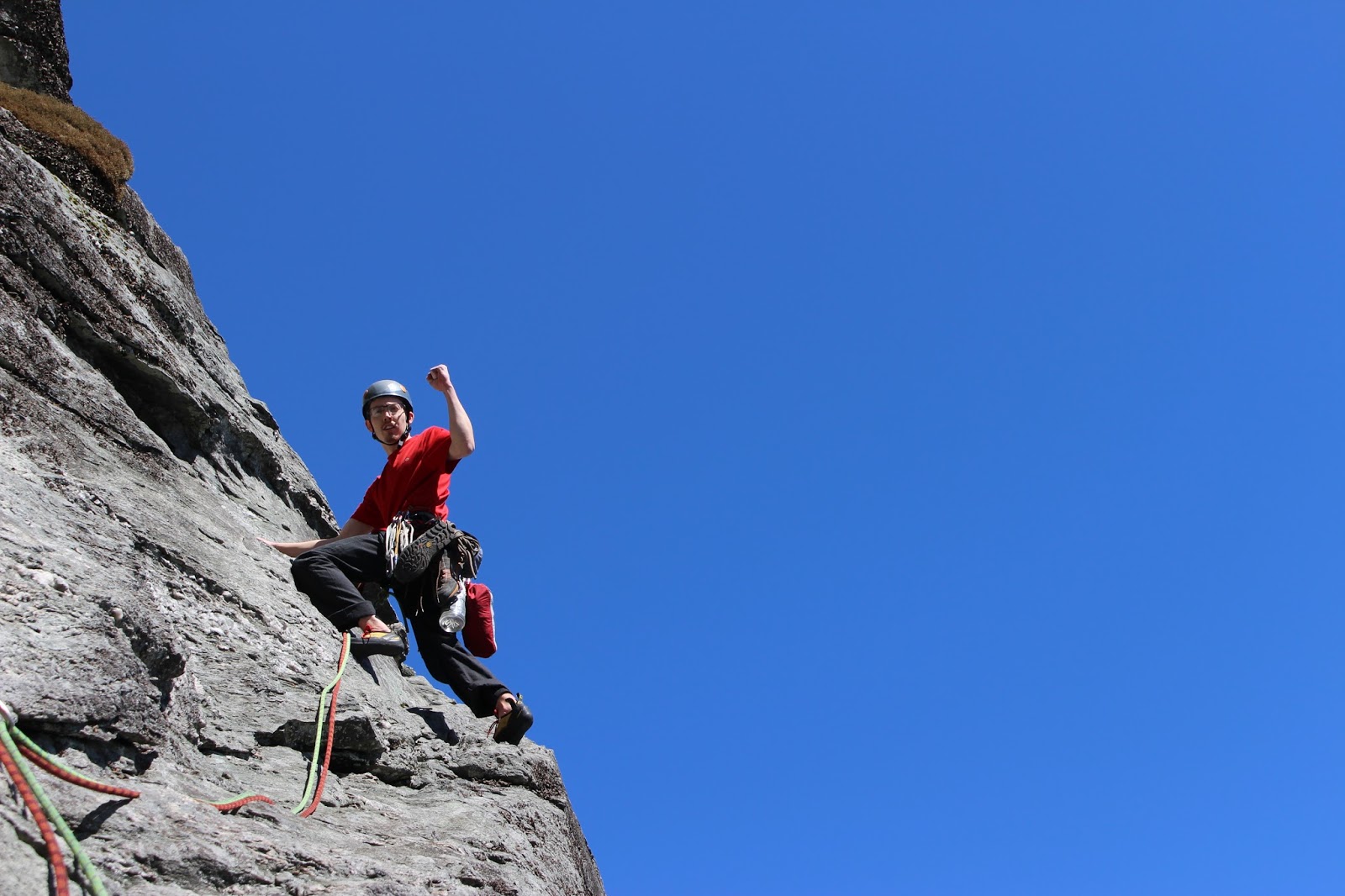
Recently, myself and two other teachers took advantage of our spring break. While our students flocked to the sunny beaches of Florida's Gulf Coast, we headed for the frosty hills of the North Carolina high country. Andrew and I have been climbing together for about two years now since I moved to Chattanooga; his meticulous attention to detail and systems and my general lack of self-preservation work pretty well together. Since Paul has only recently been learning the ways of the stone, we headed for the Southeast's Flatirons -- the Linville Gorge -- for some 5.fun adventure. 

This was Andrew's first trip to the Gorge and Paul's first time to climb multipitch so we chose to link up a few classic "5.easy" routes for a full day of vertical fun hogging: "Jim Dandy" (5.4, 3p, II) + pitch 3 of "Cave Route" (5.5, II) to the Lightning Ledge +  the low 5th class traverse and scramble to the summit. The whole thing can be done with a light rack of draws but we took a few TCU's and Aliens to sew it up.

Leaving behind the bulk of the rack at the base of "Jim Dandy"

I have described "Jim Dandy" as plain old, good, clean fun. Like bombing a hill on a skateboard fun. Or riding a bike around the city at night fun. Or rewatching episodes of 30 Rock fun. The first pitch is okay, but the second ascends a right leaning ramp into the North Carolina sky and then up a fun face and crack to a belay. I have yet to climb it without smiling. 

Pitch three is a 4th class traverse up and right to the Lunch Ledge and can be linked with p2 with some drag. In fact, having done the route twice before, I had no idea there was a set of anchors between the two. We pitched it out. Lunch Ledge is a behemoth; here, you can pick up your ropes and walk right to ascend a number of fun routes to the Lightning Ledge or to the summit. 

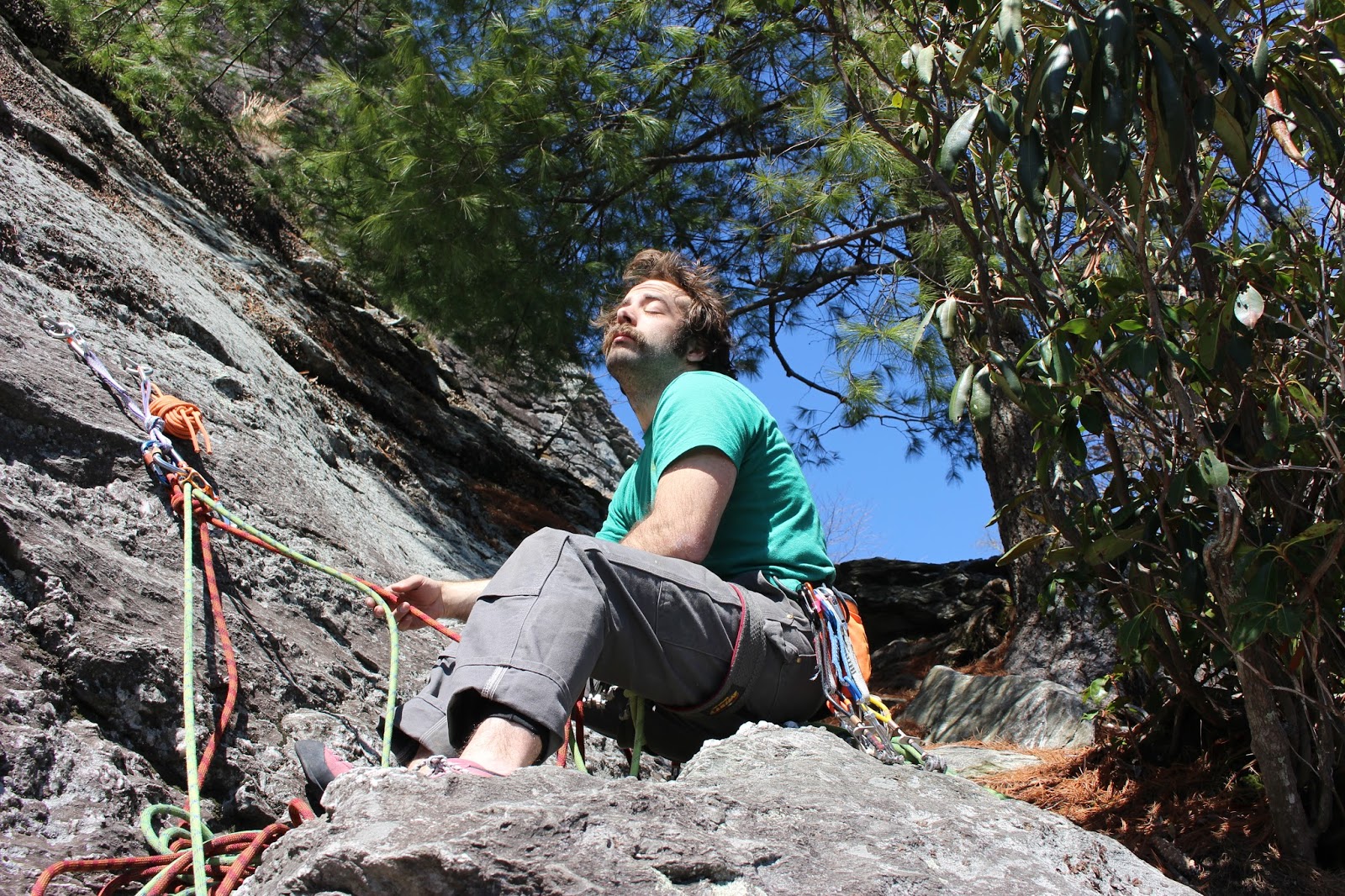
Myself looking gooood while organizing ropes at the Lunch Ledge

Andrew chose to set off on the third pitch of "Cave Route," which is separately known as "Block Route" for the eponymous dihedral with a blocky roof. Face climbing beautiful white stone with gym-like in-cuts and really fun moves on deceptively good holds high above the Pisgah National Forest make this pitch stellar. 

Andrew and Paul at the Lightning Ledge

From the Lightning Ledge we traversed back left to the low 5th class scramble out. Previously, I had only solo'd out from here but with a new climber, recent rain, and minimizing unnecessary risk, we roped up with Paul on an alpine butterfly and "hiked" it to the top. 

Finally coiling ropes after the last "pitch" 
All in all, I believe we were on the wall for about 4 hours. For reference, my buddy Evan and I simul-climbed this same link-up -- opting for "K-Mart Special" (5.6, II) instead of the "Cave Route"-- in about 20 minutes and that's with me being an idiot and getting off route for a bit. But, for a party of three on belay, enjoying the views of the belay ledges, teaching and showing along the way, rappelling once to retrieve a forgotten orange TCU, and me being an idiot figuring out rope management on double belays, we made pretty good time. 

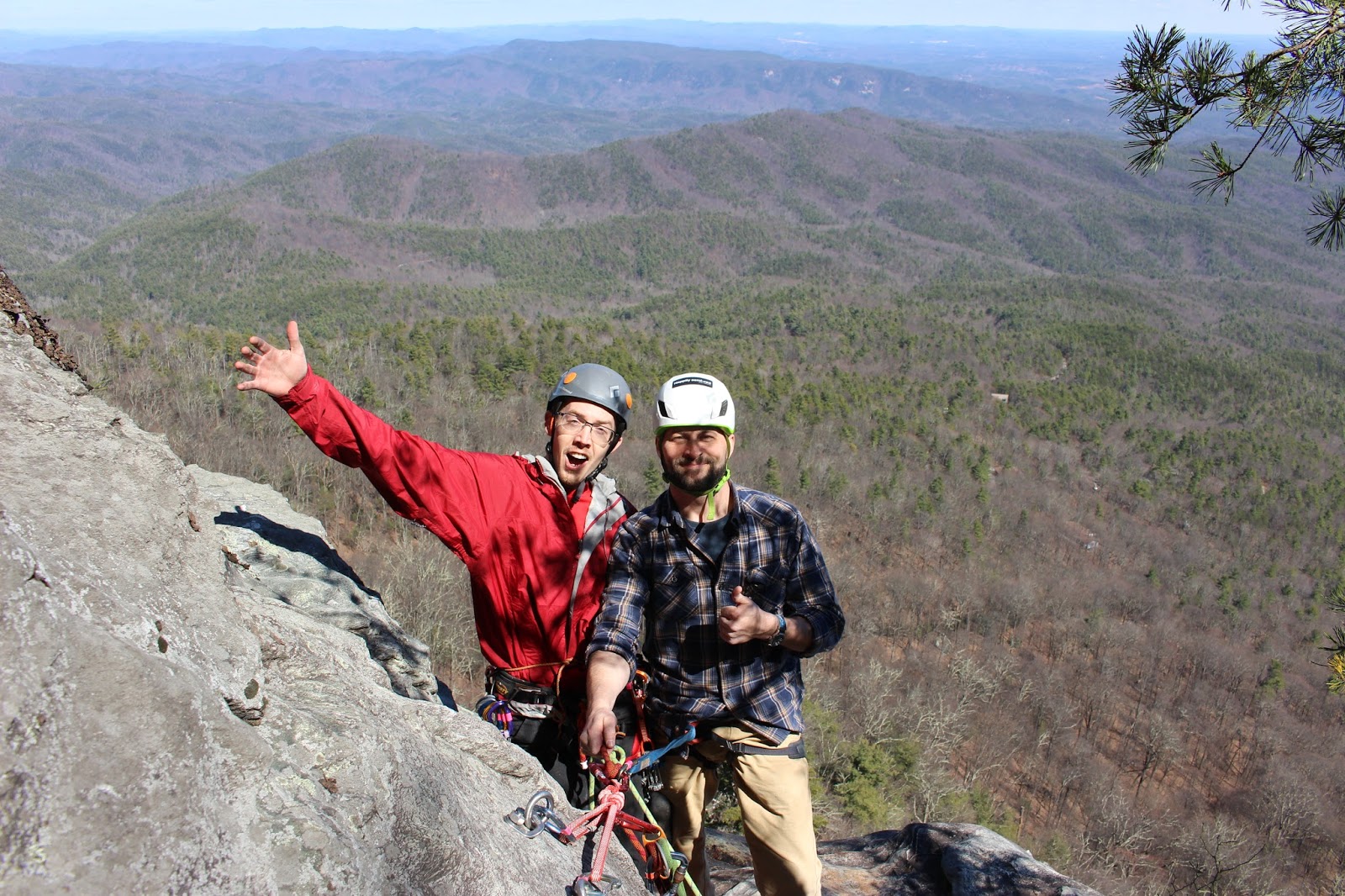
Andrew and I survey the Linville River Gorge looking toward the Amphitheater 

The summit of Table Rock offers expansive views of the deep river gorge below. And though I've worked as a mountain guide taking kids up 13-14,000 ft. mountains in Colorado, Table Rock is the most consistently windy place I've been -- spring, summer, and fall. Most of TR's climbing is protected by the southeast face, but if you climb the uber-classic "North Ridge" (5.5, 2p, II), prepare for some wind! 

Paul atop his first multi-pitch
After a day and a half of perpetual and at times torrential rain, we could not have asked for a better weather day. The rock was dry and the views were stunning. I was the most psyched for Paul who got to the summit, and said "I never imagined I'd get to do this sort at this stage in life -- I'm content." Pretty freakin' rad. 

Tuesday, March 21, 2017

Summer in the Southeast

It had been five years since I spent a summer in the South. It's hot. Like, really hot. And humid. Somewhere I read a clever acronym about summertime in the South: Snakes, Humidity, Ivy, and Ticks and it's pretty accurate. But the climbing is still oh-so good. You just have to wake up early and chase that shade. I surprised myself and climbed outside almost everyday that it hasn't rained. And since the great state of Tennessee was in a drought, that was most days.  

Summer comes pretty early in the Southeast. Come May, you're sweating just walking from the parking lot to your workplace. My workplace is a high school, so things are beginning to wind down and Daylight Savings Time means I can find time between preparing final exams to get out after school and on the weekends.

Jackson enjoys the movement on "Ethiopia" (5.10+R) at Suck Creek's Roadside Wall


On May 27, I turned in the last of my end-of-the-year paperwork and drove to the New River Gorge with new and old Chattanooga friends. Memorial Day meant the masses had come from all over and the crags felt a lot like a mega-gym at peak time. But the hordes could be avoided by climbing harder than usual on "less than classic" routes which, in turn, meant a lot of fun. 


Abi avoids the crowds by warming up on an unnamed 11 at Summersville Lake
Sydney and I catch the sunset after deep water soloing at Whippoorwhill 

I had intended to spend the whole month of June at the New but had trouble finding partners after the Memorial Day crowds deserted the gorge. Even though 48 hours of deep water soloing and margarita drinking was fun, it was not how I wanted to spend the summer, so I drove back to Chattanooga where I could have consistent partners. 

Sunset Park is without a doubt, my favorite crag in the Chattanooga area and second only to the Obed, my favorite place to climb, period. Andrew (the chemistry teacher at my school) and I have taken advantage of our summer vacations and the crag's shady west-facing cliffs to run through the south-end's classics, as well as some "no-star" moderates. Onto the northside!


Andrew follows the money pitch on Sunset's classic, but seldom travelled, "Northwest Conversion" (5.9)


Sydney beats the heat at Lake Nickajack

Summer bouldering? In the Southeast? Yes, we have that too. Some might say that Alabama's greatest gift to climbing is its boulders. But those who say that usually flock to the Heart of Dixie in January and February, when friction is prime. But down in the Little River Canyon is a treasure trove of water-marked boulders you can get all hot-and-bothered on. When you do, cool off in any number of swimming holes and soak in the gorgeous natural beauty of the place. 

Jamie gets ready to commit to an Alabama top out in the Canyon
Similarly, North Carolina's Linville Gorge offers some some spectacular water-smoothed quartzite boulders in a truly remarkable setting. I love the gorge for its big, airy, and wild multi-pitch but it was rad to experience the place from a new perspective. The bouldering is every bit as adventurous -- maybe more so -- as the towering cliffs above them.

Using word of mouth and screenshot topos, Jamie and I slogged through 1,400 to 1,600 feet of bushwhacking and boulderhopping straight down into the gorge to find a High Country heaven.
I can't wait to come back.

A very fun boulder in the Wonderland sector

Jamie cut her multi-pitch teeth at Table Rock -- eight pitches of 5.fun climbing culminating with the super fun, mega classic "North Ridge." Here she shotguns a well-deserved Busch after topping out while the "uh-oh clouds" storm across the valley.

The North Ridge (5.5)

A year ago, Josh and I traveled around the Mountain West climbing rocks together. I was guiding a trip on his birthday so I made it up to him with a PBR. This year, I earned my buddy-points by belaying him on 27 different routes for his 27th birthday. It was hard. It was ugly. There was grunting, cursing, aiding, hanging, and of course, sending. It was awesome. At the end of the day, this is what joy looks like.

Josh at the end of a birthday sufferfest.

Sunday, September 13, 2015

#dirtbagswag whips 007: My 2003 Toyota Room With a View

Josh makes some tailgate coffee in Diablo Canyon, New Mexico
Toyota Tacomas go with rock climbing like Black Diamond cams, dirty Carhart pants, and empty cans of PBR. On any given weekend, you'd be hard pressed to not see one of these fine products of Japanese engineering at any given crag in the United States. And for good reason too. They're dadgum near bullet proof, they hold their shelf life longer than canned yams, and they get pretty good gas mileage to boot.

For the climbing bum, it doesn't take much to make one of these vehicles inhabitable: a camper top and crashpad will do. But dirtbag savants have created all kinds of sophisticated truck bed sleeping apparatuses to enhance the slumber experience. I kept my methodology simple, imitating a popular tripartite system with a removable top platform and plenty of storage space along the two sides.

With the top platform in place, the bed can sleep two comfortably above the wheel wells. Slide the platform out and down and one can sleep down low with ample headroom for sitting up or for stealth camping in Wal Mart parking lots.

I dropped $360 on the Craigslist camper shell and about $100 for the bed platform materials. That's less than $500 for a mountain front room-with-a-view whenever and wherever I want. No reservations required. I can't put a price tag on the simple joy of falling asleep to the dim light of the moon, the cool breeze blowing through the screened windows, and the sound of wind in the trees. Or waking up with the sun, crawling out of my truck, brewing up a cup of coffee on the tailgate, and thumbing through the guidebook to find a place to climb that day. Those are memories that last a lifetime.

If climbing is my conduit for travel, then my truck is the means by which I experience these beautiful places. Many of which a non-climber would never see or feel. When is the last time a non-climber hiked up to the beautiful, geologically perplexing, cobble stone conglomerate walls of El Rito? Or wandered past the roadside overlooks to take in the monstrously steep sandstone cliffs of the wild and scenic Obed River gorge? I spent the past summer driving up the Mountain Standard Time Zone from Diablo Canyon, New Mexico to Ten Sleep, Wyoming. The big mountains and deep canyons are nice but I'm glad to be back in the South; waking up to fleeting fall foliage, foggy mountain mornings, and Cumberland Plateau sandstone.

A room with a view, whenever and wherever I want.

Wild Iris, Wyoming

whip specs

make and model: 2003 Toyota Tacoma Pre-Runner
moniker: pootermobile 2.0
under the hood: 2.7 L DOHC EFI 4-cylinder
gas mileage: 19-23 mpg
dirtbag mods: casette tape adapter, camper shell, bed platform, BF Goodrich All Terrains, and a "Namaste Y'all" bumper sticker

home is where you park it.